7 Polymarket Market Ideas to Watch in 2026


Why Trust Web3Bet
Our team of experts has independently reviewed and evaluated all the products and services featured on this page to ensure you receive accurate and reliable information
In 2008, the brightest minds in economics failed to predict the largest financial meltdown in modern history. Not for lack of data. Not for lack of data, but because they had no skin in the game. No one was betting real money on a crash, so no one was necessarily invested in seeing it coming either.
This is the key difference between a prediction that sounds ridiculous and an economist’s prediction that sounds plausible. One has stakes. This is precisely the problem that Polymarket was designed to solve, too.
Polymarket had, by 2024, quietly surpassed its status as a DeFi novelty for crypto enthusiasts. Gate.io analysts were hailing it as a “Truth Machine” worldwide, a tool being cited by Wall Street traders, political theorists, and mainstream news organizations. It was handling billions of dollars in volume, correctly anticipating geopolitical events before the news headlines even broke, and most provocatively of all, outperforming polling firms at their own game in multiple elections.
2026 is already looking like the most eventful year in the history of the platform. The FIFA World Cup. Possible regime changes, AI bubble worries. A possible SpaceX IPO. It’s going to be a busy year. So, we’ve selected 7 markets on Polymarket that are actually worth your notice, whether you’re here to make trades or simply to grasp where the world is actually going.
Now, let’s get started.
2026 FIFA World Cup Winner
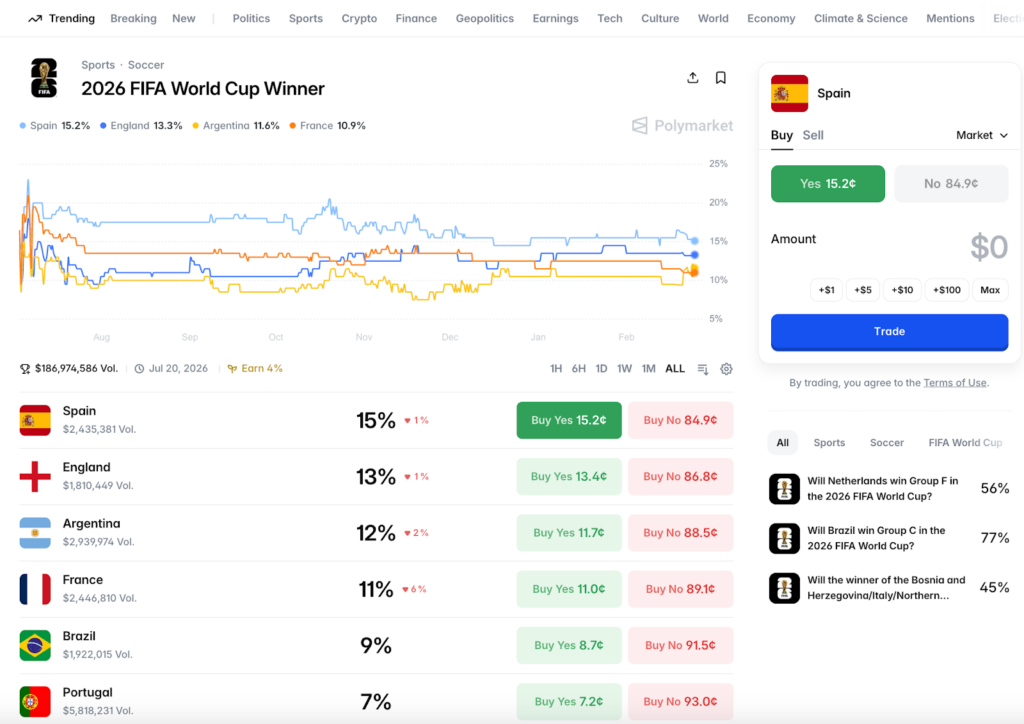
Market participants estimate Spain’s chances of winning the FIFA World Cup at 15%.
Let’s begin with this year’s largest market!
The 2026 FIFA World Cup will be one of the largest World Cups ever, with 48 teams competing in the United States, Canada, and Mexico.
The favorite to win this World Cup is Spain, with odds at 15%. Next on the list are England, France, and Argentina. If you’re familiar with football, you’ll understand that the odds of 15% for the potential champions are quite low. This, however, is the beauty of betting not only on the winner, but also on how much the market overestimates or underestimates teams’ chances.
Why is World Cup betting more than othersports?
The World Cup features a new format with 48 teams, and this means that the outcome will be based on chance, with weaker teams beating stronger ones.
The market can be quite volatile for this World Cup!
2026 NBA Championship Prediction
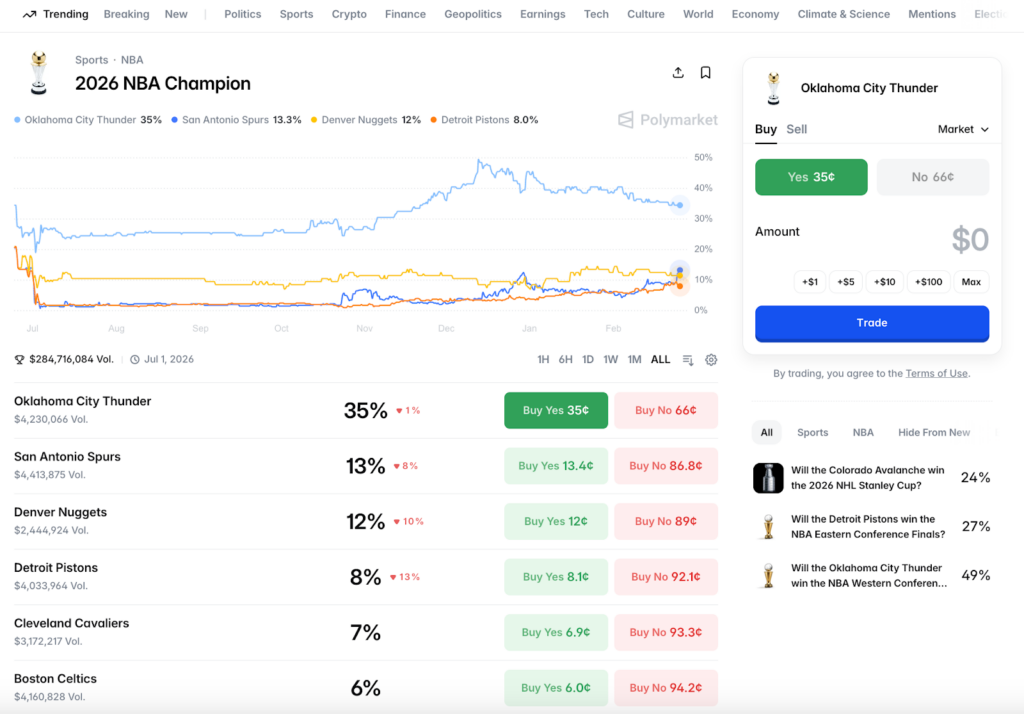
Market participants estimate OCT ‘s chances of winning the NBA at 35%.
In February 2026, Polymarket estimates that the Oklahoma City Thunder have a 35% chance of winning the NBA championship. At first glance, this may sound like a confident lead. But in the NBA, where injuries and accidents in the playoffs can change the course of any game, 35% is more a reflection of great uncertainty.
What the current market tells us:
OKC 35%: Most believe that Shai Gilgeous-Alexander and his team are the best in the league, but that’s far from a guarantee of victory.
San Antonio Spurs 12%: An interesting case a team that couldn’t even dream of making the playoffs a couple of years ago is now considered a serious title contender.
Denver Nuggets 12%: Jokic always remains a formidable force, regardless of the regular season’s outcome.
Detroit Pistons 9%: The league’s biggest sensation, and the market hasn’t yet fully appreciated their potential.
Boston Celtics 7%: The defending champions, but the public clearly expects their performance to worsen.
Trading volume on this market has already exceeded $277 million, making it one of the largest sports markets on Polymarket. Importantly, this liquidity allows for the free buying and selling of assets without fear of sharp price fluctuations, making market manipulation difficult.
3. Russia-Ukraine Ceasefire by the end of 2026
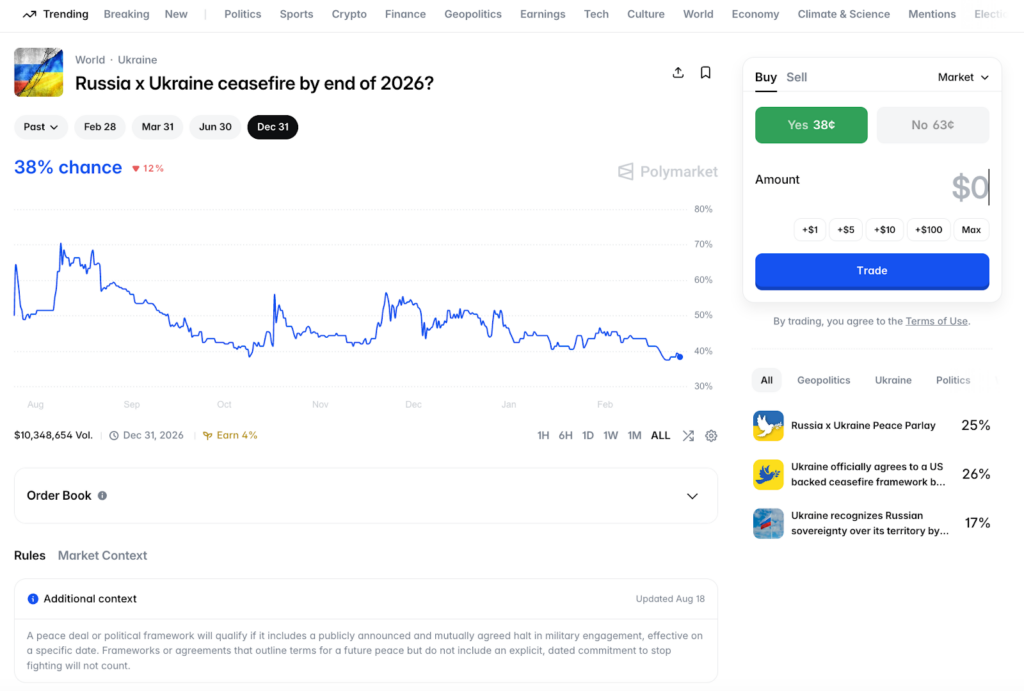
There is still no clarity on the peace talks, and the market is frozen in anticipation
The conflict between Russia and Ukraine has spawned some of the most actively traded geopolitical markets on Polymarket over the past two years. In addition to the core market for ceasefire probabilities, markets for territorial control by specific dates, city captures, and many others have emerged around it. All of these markets have seen huge trading volumes, and for good reason: the conflict directly impacts energy prices, the European security architecture, and global commodity markets.
Many market participants assumed that ceasefire negotiations were simply a matter of routine: either they would happen or they wouldn’t. In reality, the market has evolved and now accounts for partial ceasefires, “frozen conflict” scenarios, and even the possibility of a formal peace treaty that is completely different from the initial demands of both sides. This nuance is reflected in the structure of the markets’ contracts, and it is precisely this understanding that distinguishes profitable traders from gamblers.
With the start of 2026, diplomatic signals from the Trump administration have introduced new variables. Reports of behind-the-scenes negotiations, a shift in NATO’s position, and Ukraine’s domestic politics have significantly shaken traders’ expectations. The market here is heavily dependent on the emotional state of key participants, as well as the interests of states, companies, and politicians.
What price will Bitcoin hit in 2026?
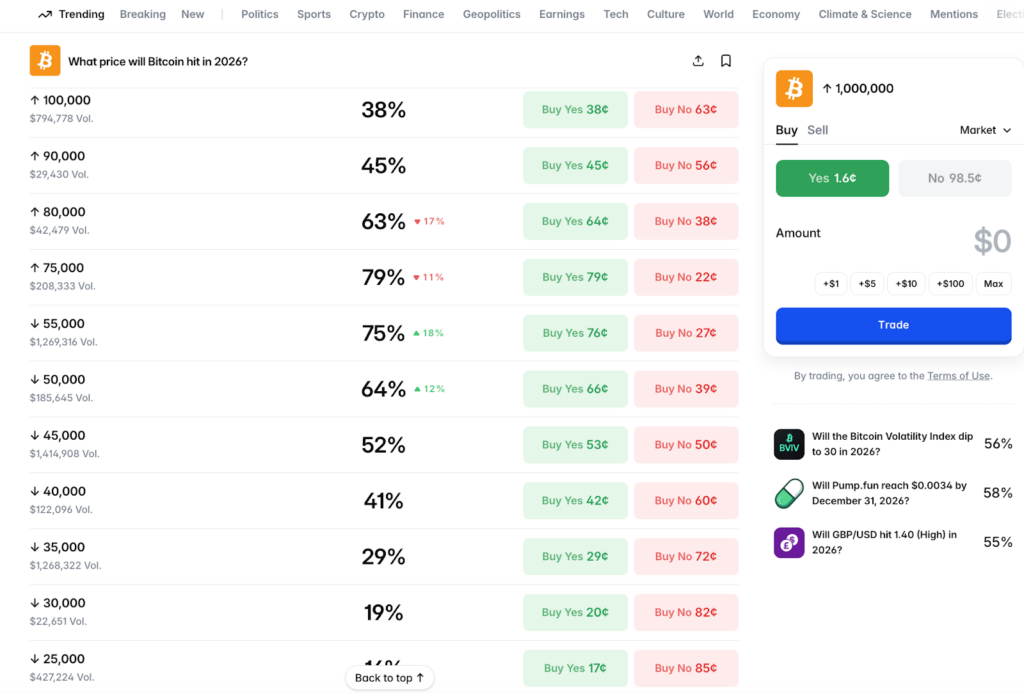
A 75% estimate suggests a high chance of a BTC decline this year.
According to most traders, the answer lies somewhere between $40,000 and $55,000, and the distribution of opinions quite honestly reflects the uncertainty of the crypto market.
The market suggests there’s a 75% chance of BTC reaching $55,000 this year, a 52% chance of falling to $45,000, and a 41% chance of falling to $40,000. This is far from a bullish scenario, or even a bearish one, but rather an uncertain one.
While analysts and crypto YouTubers are screaming about six-figure BTC prices, a collective of thousands of financially motivated participants are quietly factoring in the actual probability of the price reaching.
This doesn’t mean the crowd is always right. It just means the crowd is always honest, because real money is at stake. There is a huge difference between these two things.
5. AI bubble burst by…?
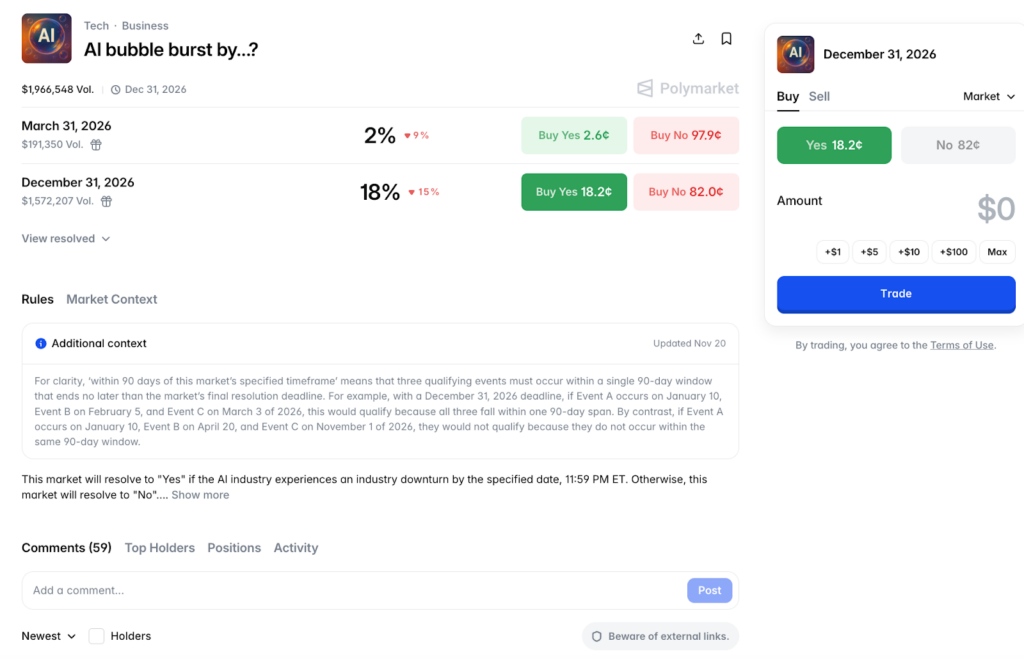
It’s the market that no one in Silicon Valley wants to exist, but everyone in finance is watching.
According to Polymarket, the market predictor of an AI market crash by the end of 2026 is estimated at approximately 40%. In other words, four in ten traders believe the current situation is a bubble that will burst before the end of the year.
For context, the wave of AI investment has been extraordinary. Company valuations are sometimes based on the assumption that they will capture almost the entire market by 2030. No one disputes that neural networks are changing our world. However, the question is: are current AI company valuations a reflection of reality or is this another wave of the dot-com boom?
The “yes” argument is based on one unpleasant fact: AI revenue multiples remain historically inflated, corporate adoption is slower than expected, and the cost of GPU computing resources continues to erode margins, while also causing severe shortages in other areas, from gaming to complex engineering. We’ve seen this before. The tulip era, the internet and een energy each trend experienced a mid-cycle crash that did not derail the long-term outlook but completely wiped out those who bought at the peak.
The argument against “yes” is just as real: capital investment by large companies isn’t slowing, software assistants and enterprise software are generating real profits, and the technology race between the US and China makes AI investments politically strategic, meaning governments will not let this bubble burst on their watch. The honest answer is: no one knows, and that’s where a prediction market like Polymarket fits in.
It’s a market for those who understand technology cycles and how they work.
How many Fed rate cuts in 2026?
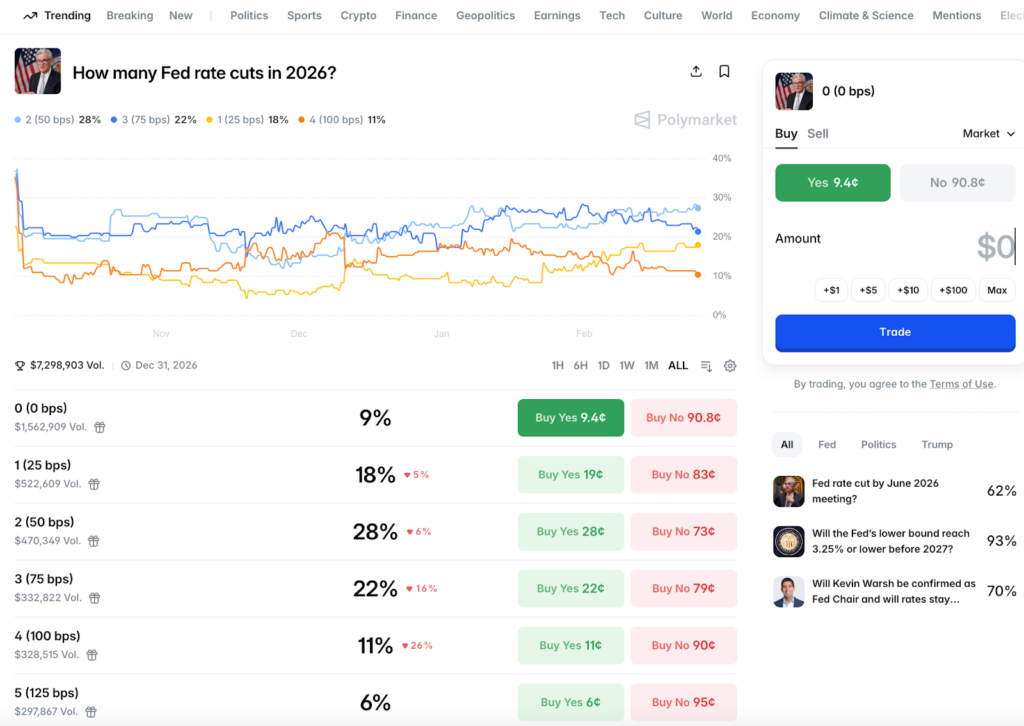
The change in the Fed’s chairman has made the market even more uncertain
Today, the Federal Reserve’s interest rate decisions affect not only bonds and the dollar, but the entire cryptocurrency market.
Looking at the numbers, the market currently assumes the following: the probability of keeping rates unchanged is about 9%, the probability of a 50 basis point cut is 28%, and the probability of an aggressive cut of 100 basis points or more is only 11%. In other words, the general sentiment is that inflation is under control, but the regulator is in no hurry. Everything will proceed cautiously, slowly, and without surprises. Incidentally, the probability of a rate hike in 2026 is only 9%.
Why is this important for cryptocurrencies? Because the Fed is currently arguably the main factor influencing risky assets. Lowering rates leads to cheaper capital, a weaker dollar, and increased institutional investor interest in alternative assets. Historically, this has been associated with the rise of the BTC price. Raising rates or maintaining them leads to the opposite effect: money flows into safe-haven assets, and leverage in cryptocurrencies becomes risky.
SpaceX IPO: A Trillion-Dollar Bet on the Stars
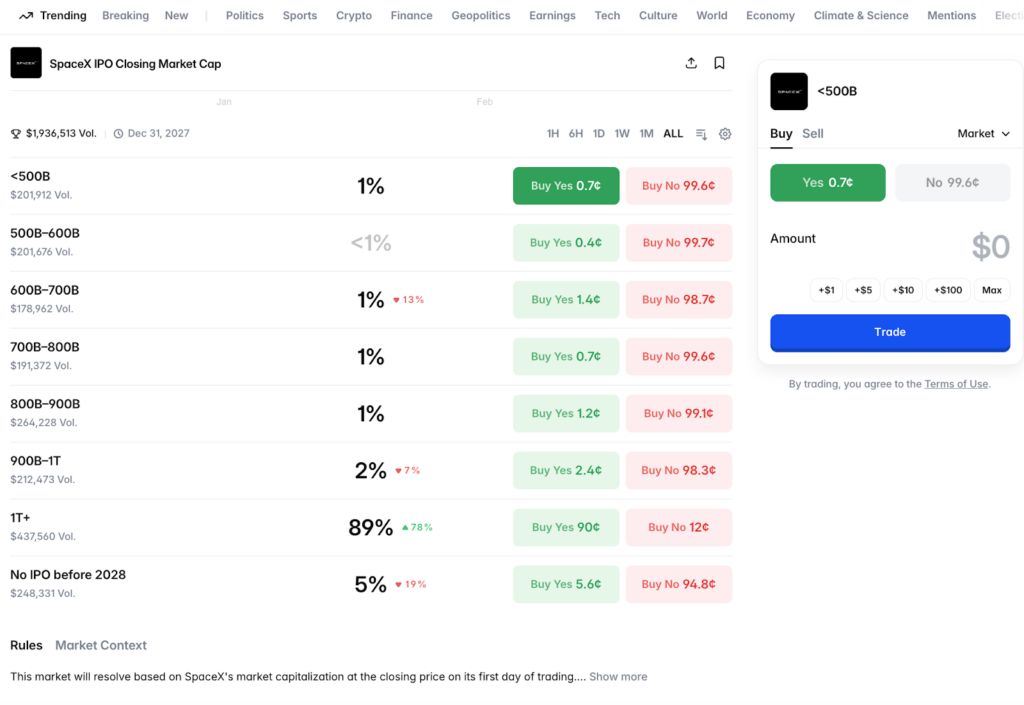
SpaceX is valued at over $1 trillion
SpaceX is like a tech white whale: privately held, worth a huge amount of money, and stubbornly avoiding going public, despite constant rumors. A new market has emerged on Polymarket in 2026: will SpaceX’s market capitalization reach a trillion dollars by the time of its IPO? The probability is currently estimated at 67%.
Consider this: two-thirds of market participants, risking real money, are confident that a company that has never been publicly traded will be worth more than a trillion dollars at its initial public offering. This isn’t just optimism. It’s a clear assessment of the value of Starlink, Starship, and contracts with NASA and the Pentagon.
The following arguments support the trillion-dollar estimate: Starlink is already earning billions in subscriptions and continues to grow, Starship could become a monopoly in the field of super-heavy space launches, and Musk’s good relations with the government give the company advantages others can only dream of. But there are also arguments against it: SpaceX has never operated as a public company, Musk is dividing his attention between Tesla, X, and government agencies, and China is actively fostering competition in the space launch industry.
But the main question this market raises is who has the best information about SpaceX’s IPO timing and the company’s true valuation? Wall Street bankers bound by non-disclosure agreements, or thousands of Polymarket users analyzing open sources?
We’ll find out later this year!
How to Trade These Markets Without Getting Rekt
Understanding the market and making money in it are two different skills. If you want to consistently extract value from Polymarket, rather than fund other people’s positions with your deposit, one rule applies: trade only what you have a real informational advantage in and at least some understanding of.
By the way, if you’re just getting started with Polymarket, we’ve written about it in detail before. We explained what Polymarket is and how the platform’s mechanics work, discussed earning strategies, and discussed common mistakes beginners make that drain their deposits in the first few weeks. These materials are a good entry point before diving into the markets in this article.
Most crypto traders, when they first encounter Polymarket, think it’s a casino. It’s not. In a casino, the house always has the advantage, since you’re playing against a well-oiled system. In a prediction market, the advantage goes to the one who provides the best analysis. In this sense, Polymarket is closer to a hedge fund than a roulette wheel, with the difference that anyone with a crypto wallet can enter. Here, you’re playing against other players, but they might not play by the rules either, so be careful!