How to Make Money on Polymarket: 5 Most Profitable Trading Strategies


Why Trust Web3Bet
Our team of experts has independently reviewed and evaluated all the products and services featured on this page to ensure you receive accurate and reliable information
Most people view Polymarket as a platform to bet on election results or some crypto news.
But people who actually make money on it see something else: a market for trading probabilities – where you can do arbitrage, hedge, and profit without needing to know the final result. This is what retail traders and hedge funds are doing in 2026.
In our last article, we explained what Polymarket is. But in this article, things get much more interesting. This is no longer about “who wins,” but about order book depth, hedging, arbitrage, and times when the market itself pushes prices in your favor as the deadline approaches.
The secret to Polymarket is time. All markets will eventually go to 0% or 100%. But if you’re on the right side of the trade, prices will often move into profit without news, without pumps, or without big movements. Most of the smart strategies on Polymarket revolve around this.
Below, we have an overview of 7 strategies that are actively employed by traders (and not just traders) on Polymarket. No theory, no financial mumbo-jumbo – just strategies that you can actually implement by hand.
Let’s take a closer look at this playbook guide to making money with Polymarket 👇
1. Bet on low volatility
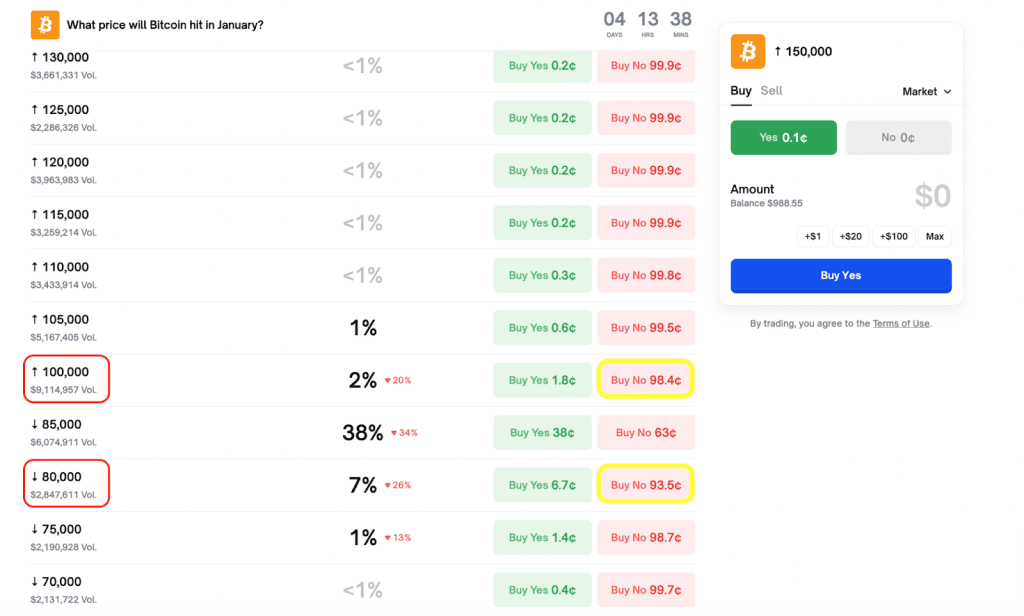
The main idea: we squeeze the price into a range, and then buy two “No” contracts for “price not below X” and “price not above Y” respectively.
You are effectively wagering that the price will be between X and Y at expiration.
Use “Stop”:
- When one of the levels in the impulse range is broken.
How to make money in this case:
- If the price stays within the range, both “No” contracts will pay off;
- You won’t have to wait for the expiration date either, as the trade will likely appreciate due to time decay, and you’ll be able to secure a 10-40% profit.
For example:
We’ll take Bitcoin at $85k, with ranges of $100k–$80k. We’ll bet on:
No on “Bitcoin ≥ $100k.”
No on “Bitcoin ≤ $80k.”
If the price closes between $100k and $80k, both positions win. If the price goes up or down, one position gains, the other loses. We close near the BUYING level as soon as delta neutrality is lost.
2. High‑volatility strategy
The main idea: You’re betting on a breakout from a range. To do that, you buy “No” on a range contract that currently contains the price (i.e., you’re betting the price won’t stay inside that range).
The logic is simple: direction doesn’t matter. The price can move up or down. What matters is that it breaks one of the boundaries and starts holding outside the range. When that happens, your position typically looks more likely to win and can rise in value.
Risks:
- There will be no any event movement;
- After a sharp move, the price returns to the price range.
The most common failure mode is a “one‑second breakout and snap‑back.” If price quickly returns inside the range, your “No” can drop just as fast. That’s why it’s important to define confirmation in advance (for example, holding outside the boundary for N minutes/hours, or a retest of the level).
How to make money in this case:
If the market moves outside the corridor, the probability of “stays inside” drops so the “No on the range” becomes more valuable.
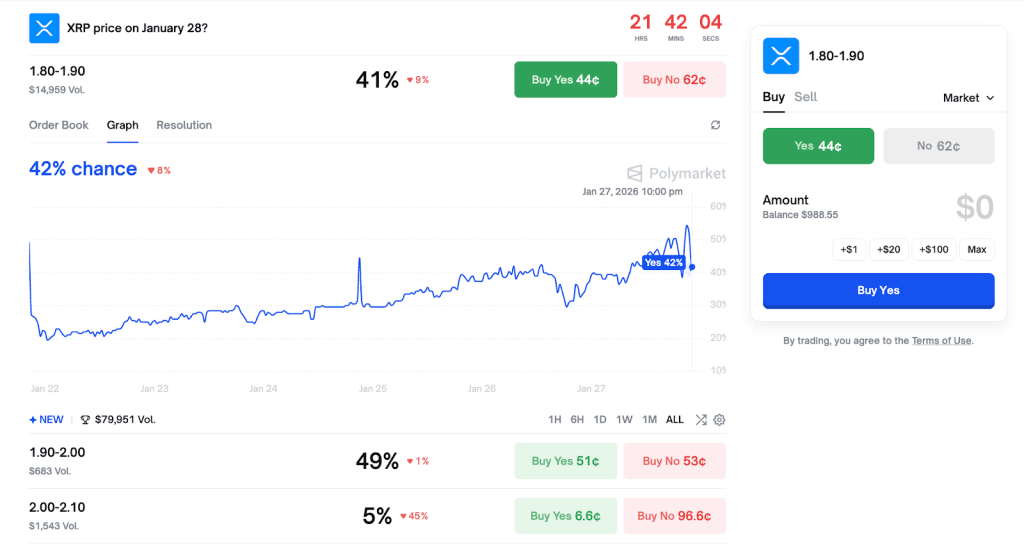
For example: XRP is at $1.90, ranging from $1.80 to $1.90. No interest in this range. The price has gone down, and the bet is closing at +50-60% in a few days.
You often don’t need to wait for expiration: after a breakout, you can take profit on the impulse, especially if the move is sharp and other traders start “chasing” the price.
Where it works best.
News/events that can trigger a sudden move: data releases, decisions/meetings, reports, deadlines, or high‑impact statements. Simply, anything that can shift expectations with a single headline.
During low‑liquidity hours (night or weekends), when the order book is thinner and price can be pushed more easily, breakouts tend to happen more often and can be more violent than during peak hours.
3. Strategy «Instant News»
The main idea: you need to enter the market immediately after important news breaks, before participants have had time to massively recalculate probabilities and reset prices. The idea isn’t to “guess the outcome,” but to catch the lag between the fact (the news) and how the market reflects it in price.
What to watch:
- Unexpected statements by politicians/regulators, urgent briefings, “breaking” news in major media outlets;
- Tweets/posts by key figures (especially if they are the source of the event itself, not a retelling);
- Release of scheduled statistics/reports (inflation, interest rates, macroeconomic data), when the important thing is not the actual publication, but the surprise relative to expectations.
How to make money in this case:
→ Use the market’s lag.
Main logic: quick entry → fixation on the first wave of revaluation (when the price “catches up” with the news) → quick exit, without waiting for the final outcome.
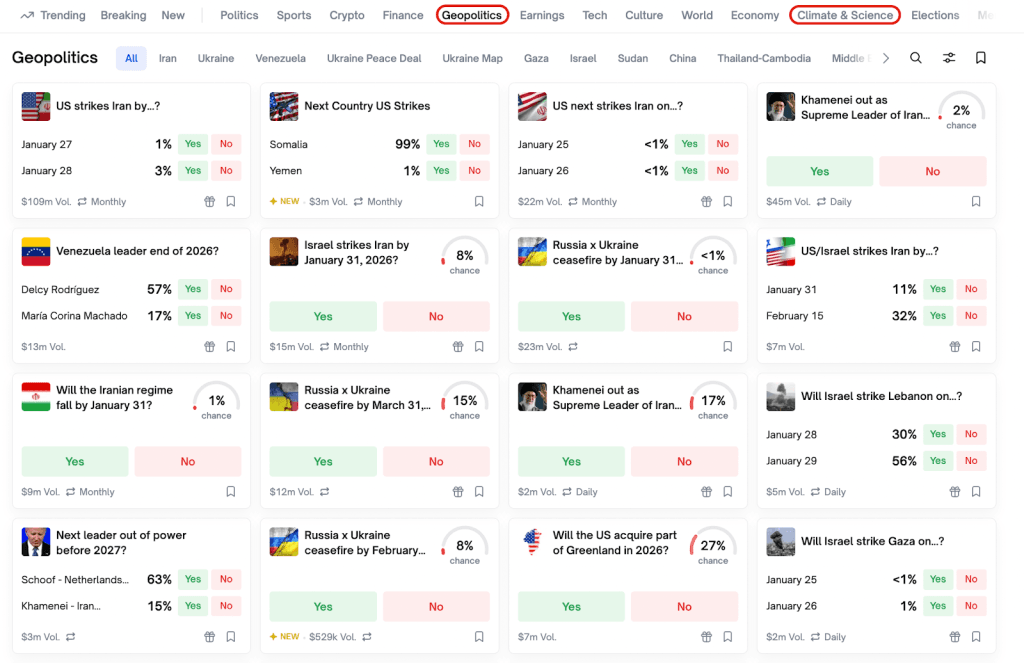
For example:
We can select any market topic: geopolitics, natural disasters, etc. Then, we just need to wait for news and open a bet.
4. Carry trade strategy
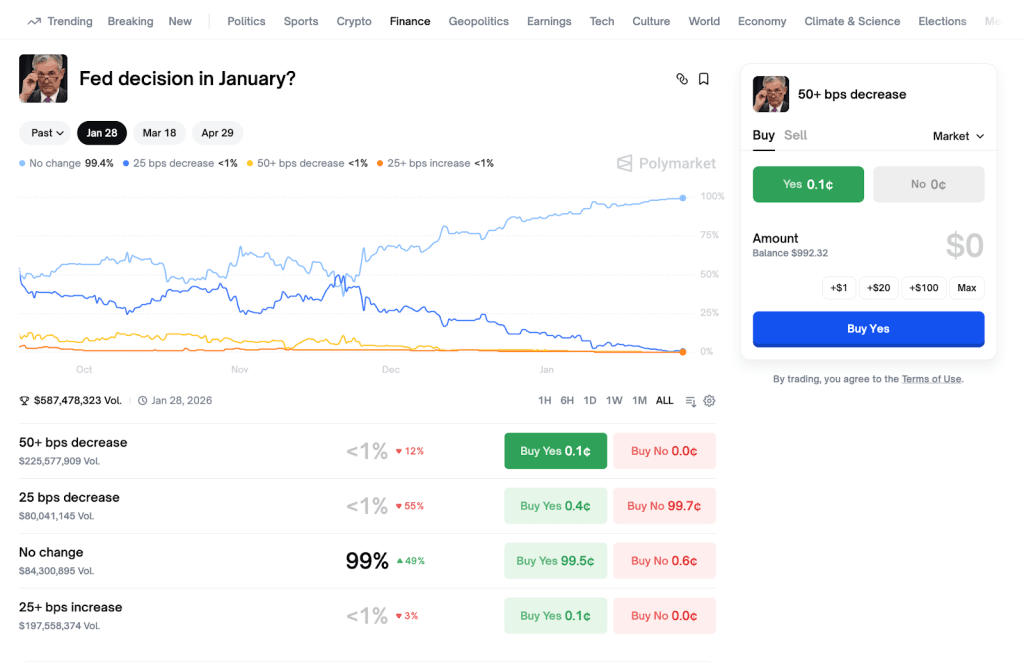
The main idea: Carry trading on Polymarket is buying a specific outcome in a long-term event and reselling it when the price rises due to time decay. It’s literally buying specific events that require you to wait until expiration. Essentially, you’re jumping on the bandwagon, and your 99¢ turns into 100¢.
When to use:
When the event is almost certain (>90% probability), but the payout has not yet occurred.
When liquidity exists and the bet price is slowly but steadily approaching 1.00 USDC (100%).
How to make money:
From changes in perceived probability: The closer you get to the deadline, and the less uncertainty you have, the more the market will ‘squeeze’ towards 100¢.
There are many risks:
- The price may not go back to ‘fair value’; markets can remain ‘discounted’ for a long time due to tail risk, fees, liquidity, or fear of reversal;
- The biggest risk is a rare but extreme scenario that completely disrupts the ‘almost guaranteed’ outcome.
However, at the same time, this strategy has been repeatedly tested. For example, let’s consider a trader named bobe2, who has been steadily trading on Polymarket for three years without complicated strategies or a lot of markets. He reportedly makes $3,000/day by focusing almost exclusively on carry trades on a small set of events. He has traded around 1,000 markets over three years. That means he researches and enters around one market per day. Most of his entries are around 99¢. Currently, he has over 5.1 million USDC in Position Value.
Providing Liquidity to Polymarket Rewards
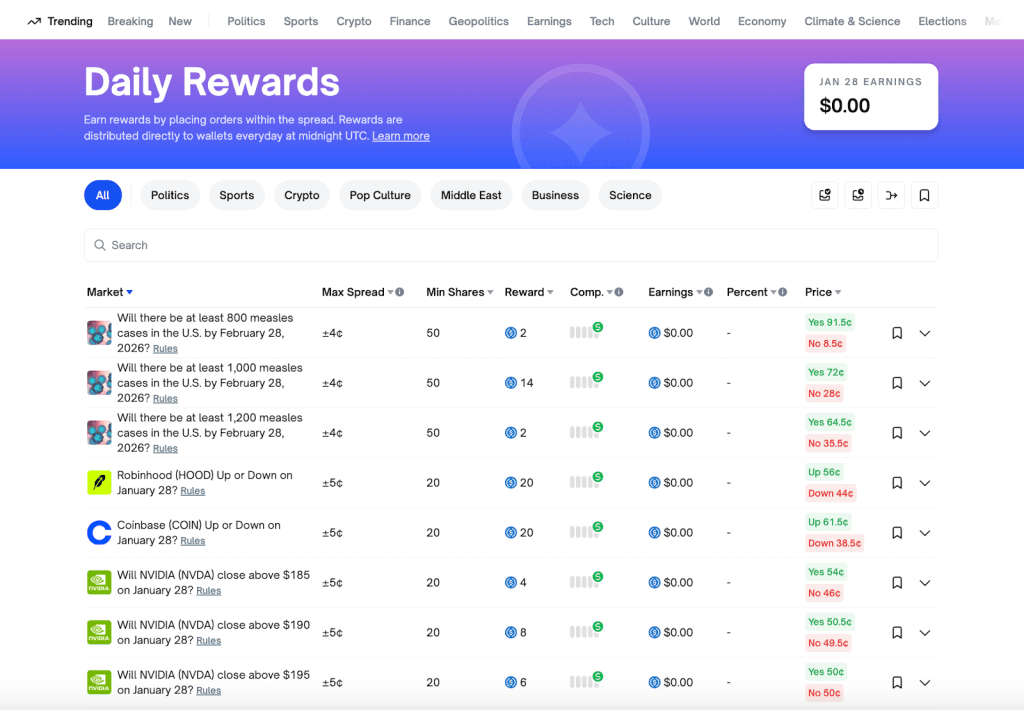
The main idea: Adding your capital to the order book on Polymarket (or other platforms) to earn commissions/spreads, as well as earning additional rewards (incentives) provided by the platform.
When to use:
- When the platform announces a program with incentives for LPs (Liquidity Providers);
- When the incentives are really high, considering risks and fees;
- When competition among LPs is not high (not a “bot war” on the order book);
- When there is still time before expiration, as well as a relatively calm event (low volatility).
How to make money:
We need to try to place orders closer to the fair price of the event, moving them regularly to avoid being kicked out of the market.
Main risks:
When you’re “taken away” from unfavorable positions (buying losing bets) by news.
When high competition “eats away” your profitability, you share the rewards as well as tighten spreads.
Take-Profit:
When expiration is near, or when the incentive is no longer worth the risk and fees.
Stop-loss:
When the price or market changes, moving outside your range (high volatility, or when you’re “worn out”).
Example:
Incentives are provided by Polymarket, but competition as well as sometimes low liquidity prevent you from profiting handsomely without infrastructure and risk management.
Conclusion
A brief overview of different strategies on Polymarket reveals that even with low liquidity and high volatility, it is possible to find repeatable entry points and create combinations with different risk profiles. The best opportunities can be found when strategies combine prediction market positions and hedging instruments like futures and options. However, these strategies are significantly more complicated compared to strategies based on bets (we will describe these strategies in the next articles).
The secret to successful trading is not just about a particular trading idea, but also about its implementation, including time decay, take-profit strategy, and correct use of stop-losses.
Polymarket provides a wide range of opportunities, from speculative trading and arbitrage to passive income generation. However, to be successful in the long term, you need discipline, a systematic approach, and correct probability analysis.
We hope this material helps you look at Polymarket trading from a different angle and use it not just for speculation, but to create balanced strategies.