KYC vs. No KYC in Betting: How Important Is It, and How Is Your Data Processed?


Why Trust Web3Bet
Our team of experts has independently reviewed and evaluated all the products and services featured on this page to ensure you receive accurate and reliable information
So, let’s first understand what KYC is.
KYC (Know Your Customer) is a mandatory identification and verification procedure for clients/users by any financial institution (be it a bank or a crypto exchange) before they begin working. It involves collecting passport information, a selfie, and sometimes proof of address to combat money laundering (AML), fraud, and terrorist financing.
The purpose of this procedure is to comply with regulatory requirements (the laws of the country in which they operate) and to protect the company from legal and reputational risks.
It works like this:
1. You upload scans of your documents (passport, driver’s license).
2. You provide your personal information (each platform has its own, as there is no uniform standard).
3. Sometimes a live photo (selfie) or video recording may be required.
Most people using betting platforms without KYC don’t really understand what they’re agreeing to. They see a sign that says “no verification required” and assume it means complete freedom with no consequences.
But that’s not the case.
In this guide, we’ll explore why KYC is important and highlight hidden triggers that may force you to undergo verification, even if the platform advertises itself as KYC-free.
What data is collected for KYC?
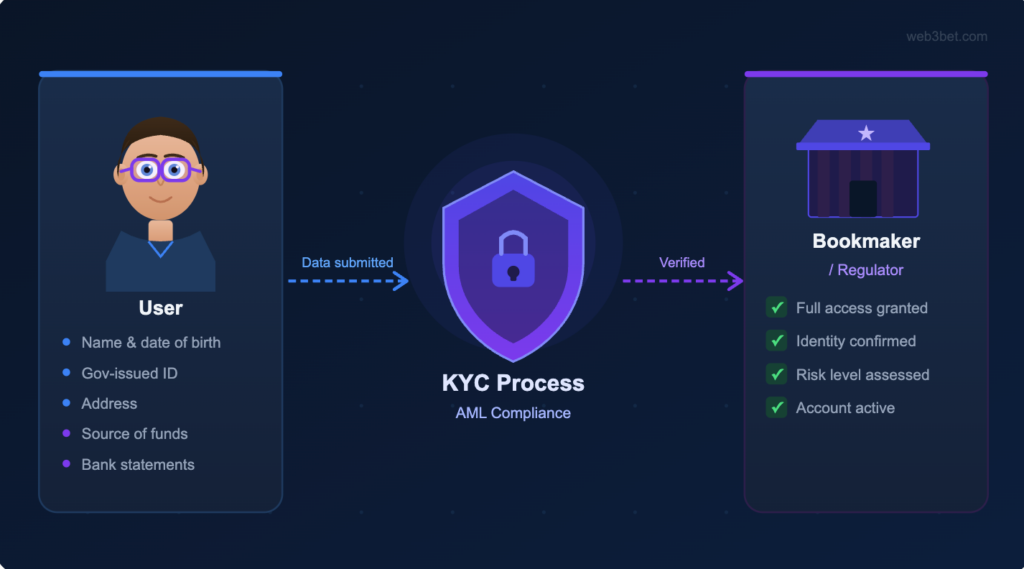
Let’s start with the most basic minimum, namely the data that all bookmakers collect by default:
- Your name;
- Date of birth;
- Government-issued ID;
- Address and country of residence.
At subsequent KYC levels, they also ask:
- Income verification;
- Source of funds;
- Bank statements;
- Or any other information.
Platforms conduct KYC not because they want to, but because regulators require it as a condition of legal operation within their jurisdiction. The logic here is simple: preventing money laundering, blocking access for minors, preventing fraud, complying with sanctions lists, and much more.
For example, if a casino or bookmaker is licensed in the UK or Malta, they have no choice but to comply, as KYC is a condition of the license. Failure to comply with this requirement results in the loss of the license and hefty fines.
What no-KYC actually means in practice
What does no KYC mean in practice?
Let’s look at another case where platforms explicitly state that they have no KYC. This usually means one of the following:
In the first case, you can make deposits, place bets, and withdraw funds up to certain thresholds without providing any identification documents. This is the most common model. Typically, the threshold is set at $1,000, after which documents are required to withdraw winnings.
In the second case, there is no verification at all, by design. These are completely decentralized platforms where smart contracts handle everything, with no company performing verification. This is a true lack of KYC in the structural sense. Such casinos have also been launched on several blockchains, but a different problem often arose: during payouts, your funds could be mixed with sanctioned/fraudulent addresses, and all your wallets would be “infected” with a corresponding flag.
Thirdly, it can be done by employing blockchain analysis for soft KYC. The website does not require your identification papers. However, it confirms your wallet address using Chainalysis or a similar service. Should your address appear suspicious, like the wallet being tied to another wallet suspected of being fraudulent or sanctions (darknet/cryptomic mixers), your account gets blocked or banned without prior notice. This means you did not provide any ID papers, but you still went through verification.
If you are not engaging in any criminal acts, there should be nothing you need to worry about during KYC. The third type of verification is more widespread in the crypto industry than one would admit publicly. From a marketing standpoint, “no KYC” means “no verification.”
The hidden triggers: when no-KYC platforms suddenly want your ID
Most KYC-free betting platforms have internal thresholds that trigger a verification request. You won’t see these thresholds anywhere. You’ll become aware of them when your withdrawal is flagged as suspicious.
- Withdrawal size triggers: perhaps the most common because typically, withdrawals of $1,000-$3,000 or less in a single transaction are normal; no triggers are required. But if you try to suddenly withdraw $5,000 or $10,000, a verification request will appear in your inbox. The specific number varies by platform and changes without prior notice.
- Aggregate volume triggers: this doesn’t just apply to a single withdrawal; some platforms track your overall activity. If your cumulative withdrawals exceed a certain threshold over 30 or 90 days, even if individual transactions were small, verification is triggered.
- Profit Pattern Triggers: This works a little differently, as the platform tracks your winning percentage. If you consistently generate profits, especially if the pattern appears more attractive than entertaining, the risk management system flags your account. This may simultaneously result in a refund of bonuses and a verification request.
- Deposit Source Flags: If you deposit from a crypto wallet previously associated with suspicious activity (scams, etc.), your account will be flagged by security. The platform may not actually inform you of the reasons for blocking your account; they will simply request extended verification.
- IP Address Geographical Inconsistencies: You registered from one country, but regularly log in from another. Or you use a VPN, and your IP address location does not match the one listed. Many platforms view this as a risk signal that triggers a manual review and often a verification request.
- Large single bets: Some platforms flag individual bets of a certain size for manual review, especially if you have a new account. Winning a large bet on the second day of activity is viewed differently by the risk management system than winning the same amount after six months of activity.
Who actually benefits from each model
It’s no coincidence that the platforms that most aggressively promote the “no KYC” slogan also employ the most aggressive, hidden mechanisms to protect against regulatory risks. This is how they address their “compliance” concerns.
The absence of KYC makes sense for you if:
You play in jurisdictions where online gambling is in a legal gray area, and you don’t need the protection of regulators. You are a relatively experienced player who wants to avoid the restrictions faced by verified accounts on regulated platforms and also wants to maintain at least some anonymity. You make transactions in amounts that will never exceed verification thresholds.
KYC makes sense for you if:
You are playing with real money and require reliable withdrawal options in large amounts. You are playing on platforms where there are authorized gambling websites, and you need consumer protection from them. You would like sustained play, which is why you do not wish to always be setting up accounts.
It’s up to you to decide which side to take!