Top 5 Newbie Mistakes on Polymarket and How to Avoid Them


Why Trust Web3Bet
Our team of experts has independently reviewed and evaluated all the products and services featured on this page to ensure you receive accurate and reliable information
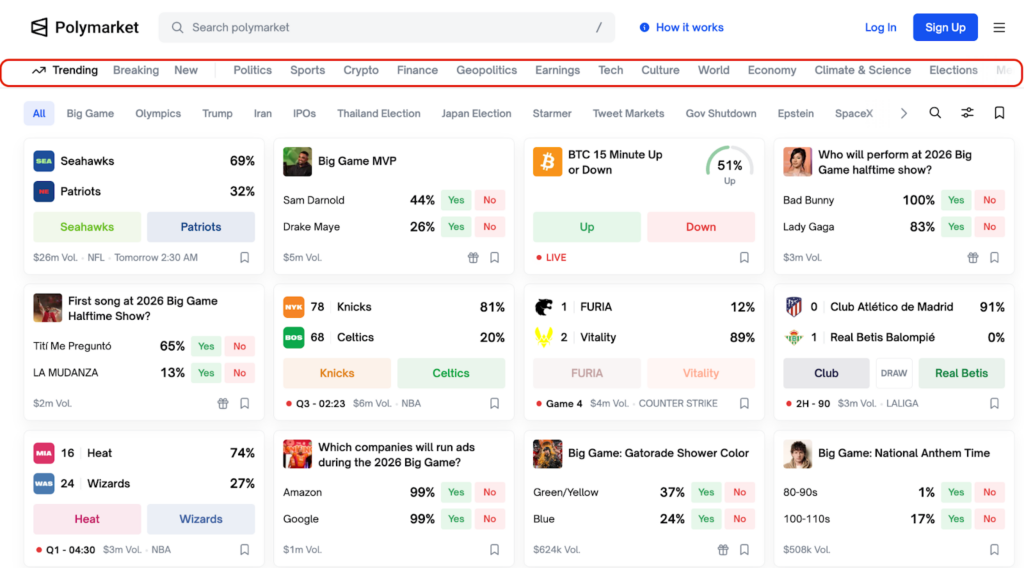
The main panel discussion is dedicated to market events at Polymarket. Choose the topic of your expertise.
The media hype about prediction markets isn’t going to pass anytime soon, and media headlines increasingly call for the regulation of them because beginners tend to lose more often. But why? They don’t lose because they “know too little”, but because they repeat the same set of mistakes: jump in on FOMO and go “all-in”, confuse confidence with probability, ignore risk management, and don’t read the market resolution terms thoroughly.
Why does this happen? In this article, we will detail the 10 most frequent errors of a beginner in the market of Polymarket and provide the most practical way to avoid these mistakes. No magic and no “secret insider tips,” but just discipline and simple rules that help you protect your capital and make decisions with a cool head.
Even in The Big Short, the characters make money not because they “guessed the direction,” but because they knew how the market actually works better than anyone. Most people have a compelling story in their head, but actually, their model breaks. It’s the same principle on Polymarket: it’s calculations and rules first, then actions.
Earlier, I already explained what Polymarket is and broke down the main strategies. If this is your first read about it, I recommend starting with those materials (ссылка на гайд по Polymarket) and coming back to this one.
Mistake #1: Not Having a Trading Plan
Many Polymarket newbies lack a strategy: how to allocate funds, how to enter the market correctly, how to diversify a portfolio of “markets,” how long to hold a position, etc. Thus, market entry and the choice of a specific market to trade are determined not by logic, but by one’s own mood and informational noise: Donald Trump’s political antics, the ranking of “2026 Olympic winners,” or “Bitcoin’s all-time high.”
The lack of a well-thought-out trading plan inevitably leads to a series of emotional decisions and large losses. A newbie monitors price movements, reads a few comments about a specific market, and inevitably buys it “before it’s too late.” They then react to events based on their feelings, expecting a correction in a given asset or locking in profits after a news update. This model lacks strategy, relying solely on emotions and random events.
Prediction markets specialize in encouraging beginners to behave in a way that triggers price movements based on news cycles. Without rules, there’s a tendency to confuse normal volatility with genuinely new information. It’s a classic scenario: buying on the hype wave and selling in panic, with positions opened without any justification and closed solely out of fear.
The solution is simple: you need to create a trading plan tailored to how prediction markets work. It includes the following key questions to answer: a rationale for why the market is undervalued; the price at which you’re willing to buy (Yes or No); where you’ll take your profit; and where you’ll admit your mistake “yes”, your stop-loss. You should also consider how to diversify your portfolio and manage your capital properly. Essentially, this involves determining how much risk you’re willing to take and how much you’re willing to lose on any given day of the week to avoid common mistakes associated with trying to “claw back a loss.”
The quickest way to determine if you even have a plan is to describe the entire trade in one paragraph before entering: reason, entry price/conditions, target price for taking profit, loss-financing conditions, and what you’ll do with the principal. If you can’t write this down in advance, you’re not trading; you’re taking an emotional risk, and that’s how most beginners get burned on Polymarket.
Mistake #2: No Risk Management control
The most common mistake on Polymarket is related to risk management: a beginner overinvests in one outcome because the outcome seems like a given. However, prediction markets do not spare overconfidence: the price can move against you on news, liquidity can deteriorate, and a series of losing trades can quickly wipe out your account.
The main problem here is not that the forecast turned out to be incorrect, but that the position size was disproportionate to the risk and sometimes even to slippage. When you trade too much on one trade, you begin to make decisions not according to the plan but to decrease stress: you hold on to losses for too long, average without justification, close at the worst possible moment, or try to “win back” with the next bet.
It is best to limit your risks per trade as well as during a certain period in advance. Decide on the percentage risk you are willing to undertake per trade. For beginners, it is best not risk above 1 to 2% per trade. Simultaneously, set a certain limit to your daily asset loss. When you reach this limit, stop trading completely and try to re-enter the market when you have cooled down (go on a break in nature, hang out with family, etc.).
And one last thing related specifically to Polymarket: think through how you will “cut your losses” will it be based on the contract price, will it be when some other relevant factor changes (like new information comes out and your probabilities update), or will it be never holding a position after some relevant time has elapsed (and it is possible to set this by expiration date)? In any case, this mustn’t be just a “feeling” based decision, but rather you actually stick to your rule, no matter how much you might “feel” like doing the opposite.
Mistake #3: Following the crowd and rumors
The most usual “killers” of newcomers on Polymarket are not malicious market making, but the risk of *FOMO. While the news is moving the price of the market contract, there comes a moment when it’s already too late to think-you need to buy in before “everyone else is coming in.” So, instead of a strategic approach, we are left to chase classic FOMO, where decisions are taken out of fear of missing out rather than some well-thought-out calculation.
Unverified assumptions, or worse, assumptions from so-called super-insiders like those from Telegram or X, are especially dangerous because they make their assumptions without any accountability, and you bear the risk of loss. Therefore, you buy not because the price doesn’t match your assumed probability, but because you’re “told” something is bound to happen, and you almost always end up last in the food chain. Essentially, you’re making an unconscious trading mistake based on FOMO (fear of missing out): you buy at a local peak and exit when the excitement dies down and the price returns to something resembling your assumed probability.
When good news becomes public, it often turns into bad news; when bad news is fully disclosed, it can become good news – a principle of investing by John Templeton.
How to avoid this trap: make “your analysis” not an abstract slogan, but a rule for entering a Polymarket position. Before entering the trade, mentally formulate your thesis in one or two sentences: what exactly you are expecting in the concrete case, why you are convinced of your probability estimate above/below the current market price, and what kind of sources you rely on (not comments from chats, only official statements, or press releases). If you have no verifiable source for your judgment, you are not entering the trade based on your analysis, but on the crowd’s sentiment. In this case, you will blow your deposit.
But the last filter, which eliminates 80% of hype trading, is pausing. While in an environment that resembles a fire, with no time left, it is the perfect occasion to stop, reread market conditions, and think – have market realities changed, or only market emotions? If it’s only emotions, then it’s better to skip trading. What you don’t know is that markets repeat themselves on Polymarket, and self-discipline will pay out more often than taking the last train.
*FOMO – Fear of missing out is the feeling of apprehension that one is either not in the know about or missing out on information, events, experiences, or life decisions that could make one’s life better.
Mistake #4: Betting Your Entire Bankroll and Timing Issues
On Polymarket, beginners often bet too much and do not understand how long to wait for a result. They either put almost all their money into a single outcome that seems obvious, or they hold the trade until the end, forgetting that their money could be stuck for longer than planned.
Betting too much is bad because one mistake can be costly. However, in prediction markets, the situation is even worse: the price can move against you for a long time, even if you ultimately turn out to be right. When you have too much money in a trade, psychology kicks in: you start reacting to every piece of news, averaging without a plan, closing at the wrong time, or, conversely, sitting in the red because it’s painful to exit.
The second part of the problem is timing. Beginners often confuse the event date and the settlement time. An event can happen today, but the market is not obligated to settle immediately. Settlement is based on the rules and sources specified on the market page. And one more thing: after the settlement offer, there is a time limit to dispute it (usually two hours). If no one disputes it, the settlement is considered correct. For some markets (especially political ones), confirmation of the result can take longer than newbies expect.
How to avoid this mistake? First, consider the stake size of your bankroll and the time the funds can be frozen. Second, before placing a bet, review the market rules and check the end date, the source of the calculation information, and any other circumstances. Because the rules (not the market cap) dictate how the market will be settled. And most importantly: never bet all your money on something where you do not know when and where the result will be confirmed. On Polymarket, this is often more important than the forecast itself.
Mistake #5: Ignoring Liquidity and jumping into unfamiliar markets.
On Polymarket, newbies see the probability (the Yes/No price) but fail to consider how trades actually occur. In smaller markets, the price appears attractive, but due to spreads and slippage, entering and exiting are expensive. As a result, you buy higher, sell lower, and even if you guess right, there’s no profit. This is especially true if you immediately enter with a market order or a large volume when the market is inactive. The trade consumes the levels, and the price is completely different from what you expected.
Not taking the spread into account when entering is a surefire way to lose your deposit. This also applies to copy trading, as whales can buy at volumes unavailable to low-bank users. The closer your limit orders are to the average price, the better. The spread is your real cost, which must be taken into account. A wide spread is like an entry tax. If the market does not move in your favor, your profit may not cover these costs and risks.
Another problem is trading in a market you do not understand. What is needed here isn’t intuition, but information, processing speed, and good sources. Otherwise, those who understand it better or have learned it all first will profit. In investing, the rule is: only do what you understand. Otherwise, you will not appreciate the risks and opportunities.
What can you do to prevent this from happening?
Before a trade, quickly check the market. First, evaluate liquidity: spread, order book depth, and slippage. Use limit orders to avoid overpaying. And ask yourself: what do I understand better than others in this market? If you honestly have no answer, it is better to pass the trade or reduce the stake to learn, not to make money.
Conclusion
Polymarket does not “punish beginners,” but it does, very quickly, teach you a lesson on the value of a good plan, risk management, and the importance of knowing the mechanism for resolution, because without this, you will almost inevitably trade on emotions and be forced to expend your own capital on the price of this lesson. If you want to earn money, as opposed to merely surviving, in prediction markets, it is actually less important to try to predict a specific outcome, but rather, as a process, to regularly, but repeatedly, execute simple tasks like calculating the odds, managing your market portfolio, monitoring the sizing of markets, and excising common noise, as well as knowing, ahead of time, when the market closes. It may sound mundane, but this is one way of differentiating trading from betting.