Our team of experts has independently reviewed and evaluated all the products and services featured on this page to ensure you receive accurate and reliable information
All casinos know exactly how many deposits they receive, what volumes they receive, and, if they’re in cryptocurrency, which wallets they use. They just don’t mention it on their website’s main page. And why should they?
In our new article, we’ve decided to gather market analysis and detail how many deposits online casinos (of those that share data) collect, and we’ll take a closer look at crypto deposits.
So, let’s get started!
The baseline: crypto’s share of online casino deposits
Three years ago, crypto represented a meaningful but clearly minority share of online casino deposits globally. The narrative was “crypto is for tech-savvy early adopters and people in restricted jurisdictions.”
That framing is outdated.
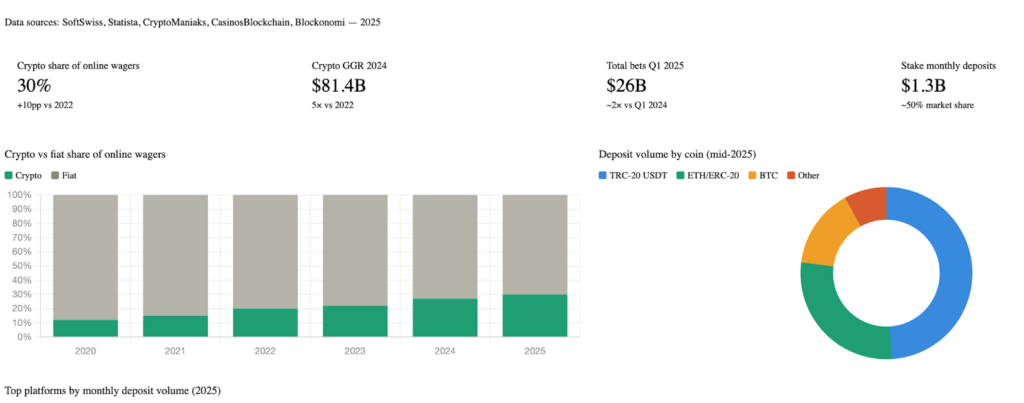
Current estimates from payment analytics firms tracking online gambling transactions place
What’s clear from the data: crypto deposit share has grown every year since 2020 without exception. The growth slowed during the 2022 crypto bear market, but didn’t reverse. When crypto prices recovered in 2023-2024, deposit volumes recovered faster than new user acquisition, suggesting existing users were depositing more, not just new users arriving.
Which cryptos do people actually deposit
Bitcoin was first. For a long time, it was most. That’s changed significantly.
USDT (Tether) is the most-used deposit cryptocurrency across all crypto casinos by the number of deposits. The latter statement may seem paradoxical, since USDT lags significantly behind BTC in terms of deposited volume. However, the explanation is simple USDT helps stabilize the deposit process.
With USDT, gamblers can make deposits without concern about the current exchange rate. If you plan to gamble with $200, you will need to deposit the equivalent amount in USDT. It should be noted that recreational players, especially, appreciate such stability, since at that moment their focus is not on making profits from cryptocurrency exchange rates.
The second or third position belongs to Ethereum, which is mostly used by DeFi users with ETH readily available in their wallets.
Bitcoin is the leading choice for larger deposits. The distribution is lopsided, with Bitcoin disproportionately represented among deposits of $5,000 or more. This is due to the crypto’s share of total online casino deposit volume between 25% and 40%, depending on platform type and geographic market. On platforms that actively market to crypto users, the number is 60% or higher.
The variation matters. A licensed UK casino with a mainstream audience and a Visa partnership is seeing crypto deposits of 10-15% at most. A crypto-native platform with no fiat rails and a DeFi-adjacent marketing strategy is seeing 90%+. The average across the industry sits somewhere in the middle and tells you less than looking at the segments separately.
Data sources: SoftSwiss, Statista, CryptoManiaks, CasinosBlockchain, Blockonomi 2025
How many people actually deposit: the real numbers
This is where aggregate data gets genuinely interesting — and where the crypto vs fiat comparison reveals behavioral differences most people don’t expect.
Average deposit sizes by method (industry estimates, 2025-2026):
Card fiat deposits: $85-120 per deposit
Bank transfer fiat deposits: $340-600 per deposit
Bitcoin deposits: $420-800 per deposit
USDT deposits: $95-160 per deposit
Rest of crypto deposits: $180-280 per deposit
There are several notable differences.
Firstly, crypto deposits are usually bigger than card deposits but smaller than bank transfers. This makes perfect sense since crypto deposits have greater friction in comparison to card deposits, but lesser than that in bank deposits. Deposits through cards are easy and can happen spontaneously for this reason, the amounts used in this case tend to be small. Bank deposits involve decision-making, leading to the decision to make the deposit.
Secondly, Bitcoin deposits are 3-4 times larger than those made in USDT. This is because of the nature of users in both cases. Users of USDT are recreational gamblers with a particular budget. On the other hand, Bitcoin users are professional cryptocurrency traders who can afford big amounts of money.
The third point to note is the following, and here is where the numbers matter for platform economics. High-value depositors tend to be crypto holders. In other words, 60-70% of all deposits come from the top 10% of depositors by volume, who predominantly use crypto.
Geographic breakdown: where crypto deposits concentrate
The crypto vs fiat split isn’t uniform globally. It tracks closely with two variables: local banking infrastructure quality and the regulatory environment for online gambling.
Highest crypto deposit share:
Southeast Asian countries, especially Vietnam, Thailand, Indonesia, and the Philippines, exhibit high crypto deposit levels compared to other parts of the world. Their banking systems lack integration, card payments from overseas are often rejected due to processors identifying gaming activity, and cryptocurrencies are popular through mobile wallets. Crypto deposits account for 70-80% of all online casino deposits in some of the Southeast Asian countries.
Latin American countries, such as Brazil, Mexico, and Argentina, have also seen a rise in crypto deposits due to the volatility of their currencies. In particular, USDT deposits in Argentina have increased significantly due to the unstable Argentine Peso.
Crypto deposit levels in Eastern European and Commonwealth of Independent States (CIS) markets are above 50%, owing to the traditional use of crypto in these regions and the difficulty of accessing Western payment processors.
Lower crypto deposit share:
Western Europe and the United Kingdom have the lowest percentage of cryptocurrency use among active gambling jurisdictions. Well-developed banking networks, broad card acceptance, and regulation of payment processors enable fiat to function effectively. Cryptocurrency serves as an alternative rather than a compulsory means of funding. Deposits made via cryptocurrencies account for 12-20% of total deposits on UK-licensed operators.
North America occupies an intermediate position. In the USA, jurisdictions are divided into states; cryptocurrency deposits are more prevalent in states with limited payment processor systems for gambling.
The fiat friction problem and why it keeps pushing users toward crypto
It’s not crypto excitement that drives deposits into crypto. It’s a fiat breakdown.
Rejections for gambling transactions via credit cards still persist. Leading payment providers, Visa and Mastercard, have been tightening the noose around gambling transactions through their Merchant Category Code systems. On top of that, banks are providing another filter through their own rejections. This means a significant number of fiat deposit attempts fail.
Statistics from the online gambling industry suggest that the rejection rate for gambling transactions by major card payment systems is between 15 and 30%, depending on the bank and country. Sometimes even higher.
Each rejected gambling transaction via a bank card is one more opportunity to push for the crypto way – “just deposit USDT – it will process immediately.”
This is understood by platforms. One can find that on many crypto-enabled gambling sites, during the initial onboarding process, one receives a direct message that crypto is a fallback option for those whose cards are rejected more often than not, crypto is offered right off the bat as the main deposit method for high-risk users.
The resulting consequence? High-risk users who deposit cryptocurrencies because their cards are rejected end up using crypto going forward, even after resolving the card issue.
What this means for bettors and players practically
When it comes to funding methods for the account in question at a cryptocurrency casino, there are some practical takeaways from the numbers.
USDT is the best option for anyone approaching it from a strict budget standpoint, since it has zero volatility and instant transfers. Also, it is compatible with most casinos.
The same goes for Bitcoin deposits if one already holds a decent amount of BTC no conversions are needed in this scenario.
Funding with fiat money via credit card is going to be the easiest way for newcomers until the card is declined during registration. Prepare an alternative beforehand to avoid problems creating a wallet.
Bank transfers for fiat should be used only for large amounts, as they are not allowed on such platforms with good withdrawal rates.
The direction of travel
The percentage of crypto in casino companies’ deposits will only rise. Not because crypto maximalists won a culture war, but because the inherent structural benefits accrue as more users use them.
Fiat currency is here to stay. Mainstream gambling services targeting mainstream audiences will continue to offer card payments and direct bank transfers as primary options for many years to come. Yet, every single payment friction moment pushes another user toward using crypto rails.
Those online casinos that realized this early on designed their products for crypto-first use cases. Those who treat cryptocurrencies merely as a supplementary payment method see their top depositors move elsewhere.
The Web3Bet ranking in each country is based on a multi-factor weighted model that evaluates the popularity of casino and sportsbook brands. All data is collected and analyzed for the previous month.The model includes three key parameters:Search demand (80%): measured by Ahrefs monthly search volume.Google Trends (10%): popularity dynamics based on user interest measured by Google Trends.Indexed keywords (10%): the number of keywords in Ahrefs’ index for each brand.Each brand in the Top 20 is assessed across these factors, assigned a composite score, and ranked accordingly.This approach ensures an objective and data-driven evaluation of the popularity of casino and sportsbook brands in any given GEO.