Kalshi, the first fully regulated event-trading platform in the US, is CFTC-certified and operates under a regulatory framework that most of its competitors cannot access. That’s why it has the distinction of working with CNN, CNBC, and Robinhood, and of having a monthly trading volume of more than $5.8 billion.
But how did the journey of the Kalshi platform begin? Not many knew of the platform when Polymarket was the latest craze. Let’s continue our review!
What Is Kalshi, and Why Is It Different
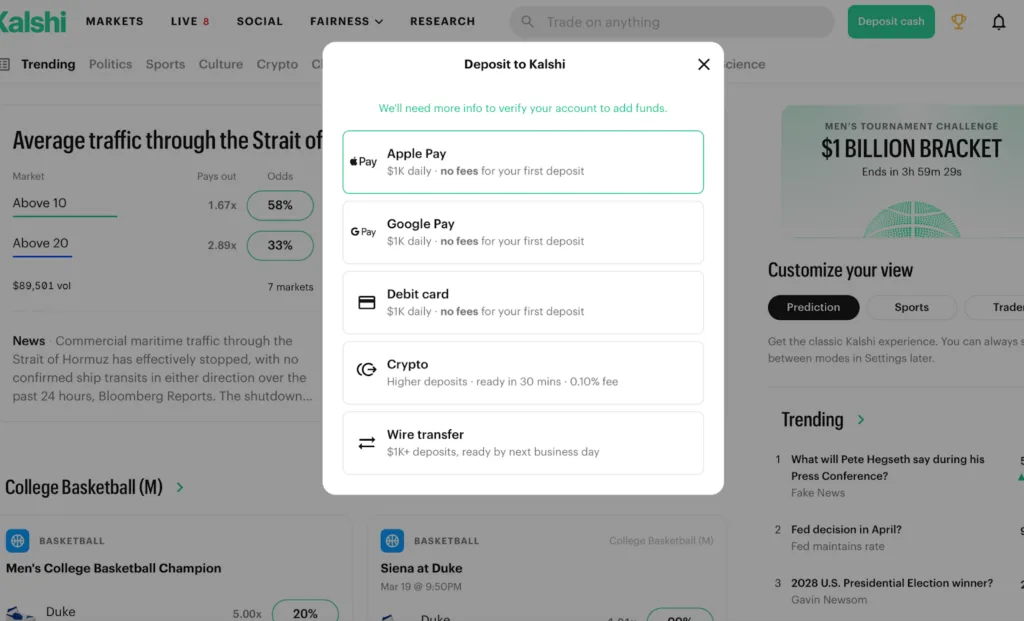
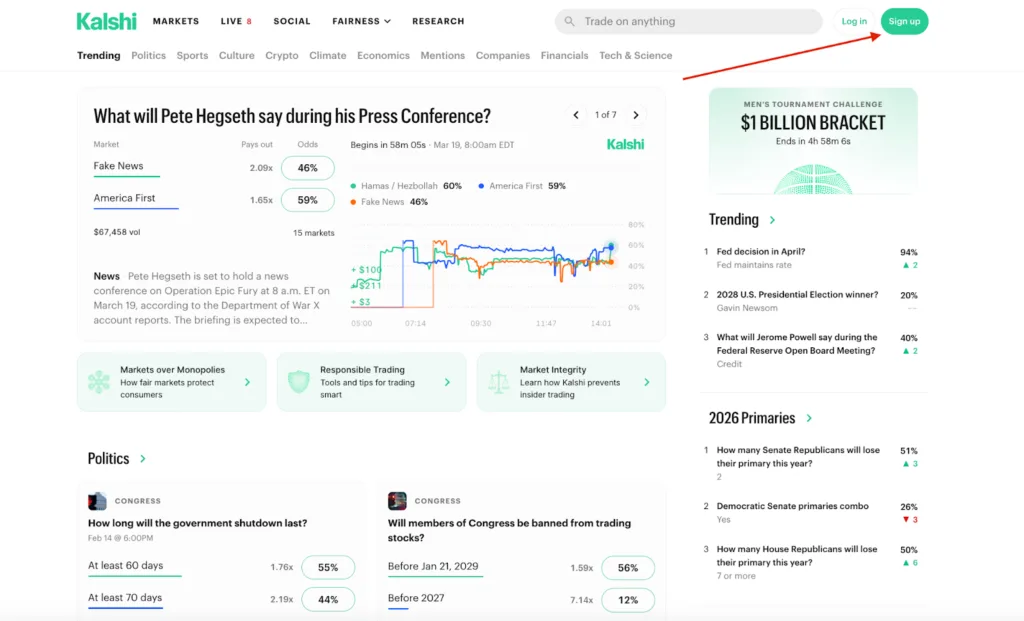
This is what Kalshi’s main page looks like, where participants make their market predictions.
Kalshi is a prediction market, like Polymarket, a platform where you trade contracts on the outcomes of real-world events.
Similarly, you buy “yes” if you believe something will happen, and “no” if you don’t. Each contract pays exactly $1 if you’re right and $0 if you’re wrong. The price you pay for that contract reflects the market’s collective assessment of probability.
How Kalshi differs from Polymarket:
- It’s federally regulated: Kalshi is a designated contracts market and is regulated by the Commodity Futures Trading Commission (CFTC), the same as the CME Group. Kalshi was the first event contracts exchange to be regulated by the CFTC and to go public in the US, doing so in 2021.
- It’s in US dollars: No crypto wallet is necessary. Funding can be done via bank transfer, debit cards, PayPal, or Venmo. This way, it’s accessible to individuals who have never used crypto before.
- No stake limits: Previous legitimate prediction markets, such as PredictIt, had a stake limit of $850 per market. Kalshi does not have such limits. This is why it’s used by institutions and serious traders.
- Kalshi contracts are available inside the Robinhood interface. You can trade alongside stocks without creating a separate account.
The name itself comes from the Arabic “Kalshi,” meaning “All.” The founders, Tarek Mansour and Luana Lopez Lara, spent years litigating with the Commodity Futures Trading Commission (CFTC) over the admissibility of election contracts. In 2024, they won the case. This victory defined the platform’s current structure.
As of October 2025, according to Messari, Polymarket has slightly higher volume, while Kalshi leads among verified traders in the US. Kalshi is valued at approximately $5 billion, while Polymarket is valued at $8-9 billion following a major investment from Intercontinental Exchange.
Kalshi’s key goal was to create a fully regulated platform like Polymarket, and they succeeded.
What You Can Trade on Kalshi
For those unfamiliar with Polymarket, there’s plenty to see, but even the “experts” will find something to enjoy!
Kalshi Sports UX-Interface
Economics and Finance
This is the main domain of Kalshi, and users can bet on events such as Fed rate decisions, CPI, unemployment, and GDP releases. If you’re interested in macroeconomic events and you think the market is underestimating the outcome of the next Fed meeting, as a user, you can express your opinion by creating a contract, which will be priced in cents and paid in dollars if you’re right.
Sports
The sports market on Kalshi took off in 2025 and hasn’t stopped since. In fact, sports make up over 90% of all activity on the platform and 89% of all revenue generated by the end of 2025. Sports include the NFL, NBA, MLB, NHL, college sports, and much more. However, the case is even more complex, despite the regulations. In fact, sports betting was blocked in January 2026 by a court in Massachusetts, citing state gambling laws.
Politics
Election results, legislative acts, and geopolitical conflicts are the most discussed topics on Kalshi. Critics say election betting undermines democratic norms, while supporters argue that real money at stake yields the most accurate predictions. Both arguments are compelling. In any case, political markets are among the most actively traded on the platform and typically attract the most media attention.
Other markets
Award ceremonies, weather events, tech company announcements, company news, and entertainment event results. Some of these events are genuinely interesting if you closely follow a specific niche. The key is to know what’s what before investing, because the market doesn’t care whether you’re trading analytical data or simply betting on luck.
Overall, the offerings here are almost identical to Polymarket, with one huge BUT. The wide latency between platforms creates a significant arbitrage opportunity (as we discussed in one of our articles). So if you’re interested in this method of earning money, Kalshi will definitely be of interest to you.
How Kalshi Actually Works: The Mechanics
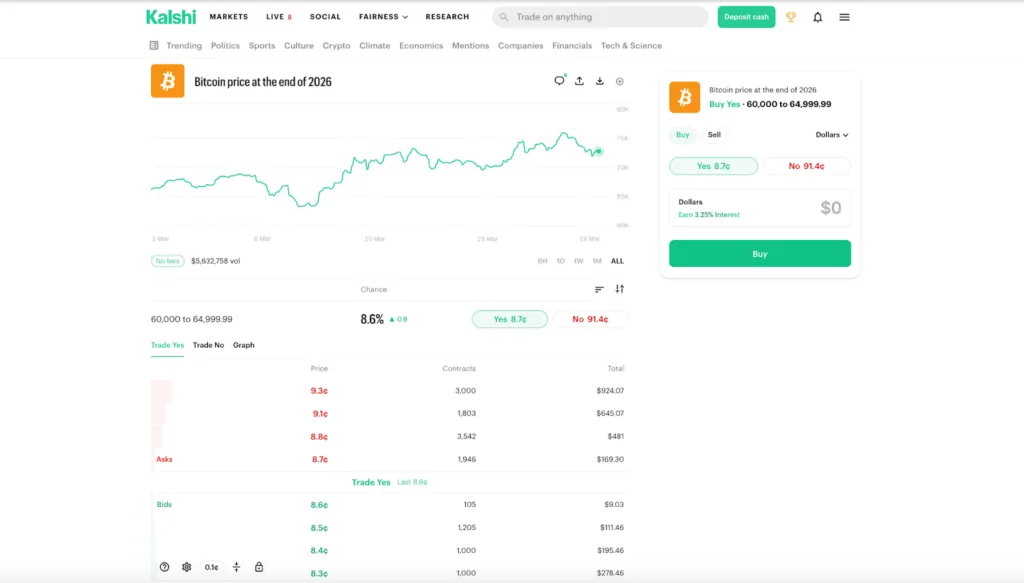
An example of what the order book looks like on Kalshi. Essentially, the interface is not much different from Polymarket.
This section is essential for beginners, as understanding it will help you avoid the most obvious (and less obvious) mistakes and, therefore, save (and possibly increase) your deposit.
Order Book
Kalshi, like Polymarket, uses an order book. There is no broker setting prices. Prices fluctuate based on supply and demand between traders (P2P). Every market has two sides: “Yes” contracts and “No” contracts. At any given moment, there is a best bid (the highest price someone is willing to pay for a “Yes” contract) and a best ask (the lowest price someone is willing to accept), and the difference between them is the order book spread.
Important: The sum of the “Yes” and “No” contract prices is not always exactly $1. If a “Yes” contract is offered at 60 cents and a “No” contract at 43 cents, then buying both will cost $1.03. This 3-cent difference is your effective trade cost before commissions. In liquid markets, spreads are small. In low-liquidity markets, they can be 10-15 cents or more. This is the MOST IMPORTANT step to check before every trade.
Calculations
When a market closes, Kalshi determines the outcome based on a predetermined source of approval, such as official government data or verified sports results (media reports, for example, can also be considered). Winning contracts are settled at $1. Losing contracts are settled at $0. You can either hold the position until it closes or sell it early, locking in a profit or locking in a loss at the current market price.
The Fee Structure: Read This Before You Trade
This point is very important, as many are accustomed to the absence of fees on Polymarket (However, since 2026, a fee of approximately 1.56% has been introduced on crypto contracts).
Kalshi’s fee structure appears simple at first glance. It is not.
The formula for the taker fees is: 0.07 x P x (1-P), where P is the contract price. This generates a parabolic curve, with the fees peaking at 50 cents, then declining towards 0 and 100.
In practice, the fees work like this:
- 50 cents (maximum uncertainty): Fee per contract: 1.75 cents. That’s about 3.5% of your stake.
- 20 cents (long shot): Fee per contract: 1.12 cents. That’s about 5.6% of your stake.
- 90 cents (high-confidence outcome): Fee per contract: 0.63 cents. That’s about 0.7% of your stake.
The idea behind the fees: the more certain the outcome, the lower the fees. It’s very cheap to trade markets with high confidence. But the markets we traders care about the most—the markets with the highest uncertainty, the markets between 40-60%—are the most expensive.
In April 2025, Kalshi also introduced maker fees on certain markets, depending on the probability. These fees were scaled in a similar manner to the taker fees.
Getting Started: The Practical Steps
If you want to actually trade after reading this, here is the setup:
1. Create an account at kalshi.com. U.S. residents go through standard identity verification. International users outside restricted jurisdictions can also access the platform.
2. The deposit options are quite good. You can pay directly with a card, top up via Wire Transfer, or use crypto.
3. Find a market where you have an actual edge. Not one that looks interesting. A market where you believe the current price is wrong, and you have a specific reason for that belief.
4. Use limit orders. Don’t click market buy on illiquid contracts. Set your price, place the limit order, and wait. You save on fees and avoid bad fills.
5. Track every trade. What you expected, why, and what happened. Without this record, you cannot know whether you have a real edge or whether you have simply been lucky.
Why Kalshi Outperforms Other Prediction Platforms
The prediction markets are becoming part of the financial data ecosystem. As a regulated entry point to this ecosystem in the US, which is vital for widespread adoption, Kalshi is at an intriguing crossroads between finance and outcome prediction.
The most intriguing thing, though, is the difference between prediction markets. The prices of the same event on Kalshi, Polymarket, and other prediction markets may differ. Arbitrage income for traders who can trade across all markets simultaneously is the difference between these prices. Kalshi’s regulated status makes it the purest entry point for this type of arbitrage. It is also becoming increasingly liquid, approaching levels of Polymarket.
This is a unique combination in an industry still in its infancy. The idea is not to compete with prediction markets. The idea is to leverage the strengths of each prediction market to boost your arbitrage income more effectively.