Polymarket Alternatives: 5 Best Prediction Market Platforms

Polymarket, which gained widespread attention during the 2024 US presidential campaign and was widely covered by journalists, emerged as the platform with the most liquidity in political markets. Then, many began talking about Kalshi as an alternative to Polymarket with greater liquidity.
But Polymarket and Kalshi aren’t the only prediction platforms on the market. Depending on what you’re trying to do, trade cryptocurrency price predictions, bet on sports results, access markets Polymarket doesn’t offer, or operate from a jurisdiction where Polymarket blocks you, there are more suitable alternatives.
In this review, we’ll look at seven prediction market platforms that are truly worth your attention in 2026. So, let’s get started!
What to look for before picking a platform
Before going to the list, let’s just cover some things that actually matter in prediction market analysis:
Liquidity: In illiquid markets, wide spreads and slippage result. Better for you to choose from fifty markets in an active prediction market environment rather than five hundred illiquid ones.
What mechanism is used for settlement? Centralized group or decentralized oracle? All of these come with specific disadvantages.
What types of markets are available? Politics, cryptocurrency, sports, science, customization? The prediction market should support your needs.
Access by geographic location: Some prediction markets impose limitations on which countries are accessible, while others do not.
Trading, withdrawal fees, and spreads. All of these contribute to the bottom line. Prediction markets differ from one another.
Now let’s move on to the actual list.
1Win Predictions
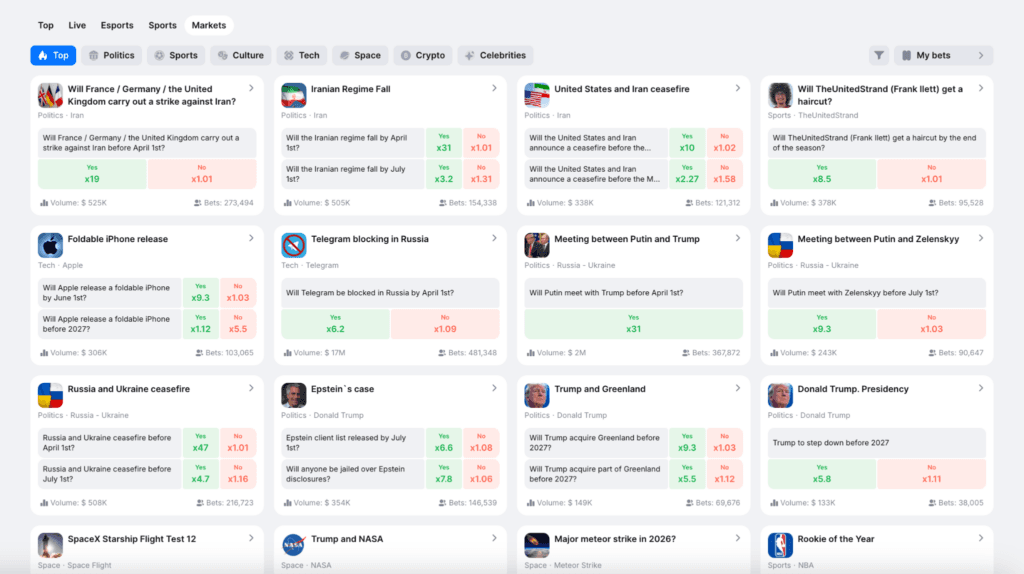
1Win prediction platform interface.
Best for: non-US users who want real-money prediction markets with a betting-native UX
The market prediction section (1win.com/betting/markets) employs a completely different approach than the previously listed cryptocurrency websites. While there are no share bets from 0 to 100 cents available, 1Win offers usual odds by bookmakers, Yes/No options with x1.01 multiplier or something like that. Anyone who has ever engaged in sports betting will instantly recognize the user interface, whereas Polymarket traders may find it difficult to adapt to it.
The diversity of offered market categories is definitely surprising since it was supposed to be only a place for sports betters. However, it now offers the Politics and Celebrities markets, among others. This means you can trade on geopolitical events in Iran, the release date of a new iPhone with a folding screen, legal issues surrounding the Telegram app in Russia, and even SpaceX launches. Every single card contains information about volume and positions.
What 1Win does well:
- Real-money markets without a crypto wallet setup, deposits work through standard payment methods
- Broad category coverage, including markets that Polymarket and Kalshi don’t list
- Multiplier-based odds that are instantly readable for anyone from a sportsbook background
- Accessible from most non-US jurisdictions where crypto prediction markets are blocked or legally unclear
Where it falls short:
1Win operates under a Curaçao license, which is important, but not on the level of regulation that Kalshi enjoys due to its CFTC authorization. Users from the United States are banned. The process is centralized, meaning the company itself determines the results, not oracles or token owner votes.
If you are looking for real-money prediction markets with a gambling website-like interface and more market options than typical decentralized websites offer, then it might be worth trying out 1Win’s Markets tab.
Azuro
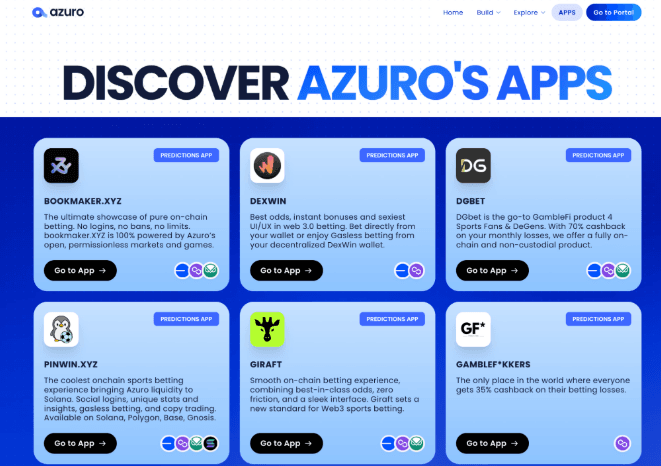
Azuro prediction platform interface.
Azuro isn’t just a platform; it’s an infrastructure and ecosystem for prediction markets. It’s kinda an App Store for prediction apps. We decided to include it in this list to demonstrate that an ecosystem of projects can be built around it.
Azuro itself is a decentralized protocol that other interfaces are built upon. Therefore, when using a betting platform built on Azuro, you interact with the same underlying liquidity pools and smart contracts as all other protocol participants.
The LP (liquidity provider) model makes Azuro technically interesting. Liquidity providers contribute funds to pools. Players bet against these pools. The protocol margin is distributed among the LPs over time. This is a truly decentralized betting model, in which only the protocol and the users are involved.
What this means for players
Odds are set algorithmically based on the composition of the pools and the volume of bets. This creates vulnerabilities when pools are unbalanced, especially in low-volume esports markets, where a single large bet can significantly change the odds.
Settlements occur via a smart contract when oracle data confirms the outcome. There is no manual verification, no withdrawal approval process, and no trust in a centralized team.
Limitations
Liquidity varies greatly across individual markets. Major football matches have significant pool volumes. Niche esports events may have such a small number of participants that your bet can significantly impact your own odds.
Manifold Markets
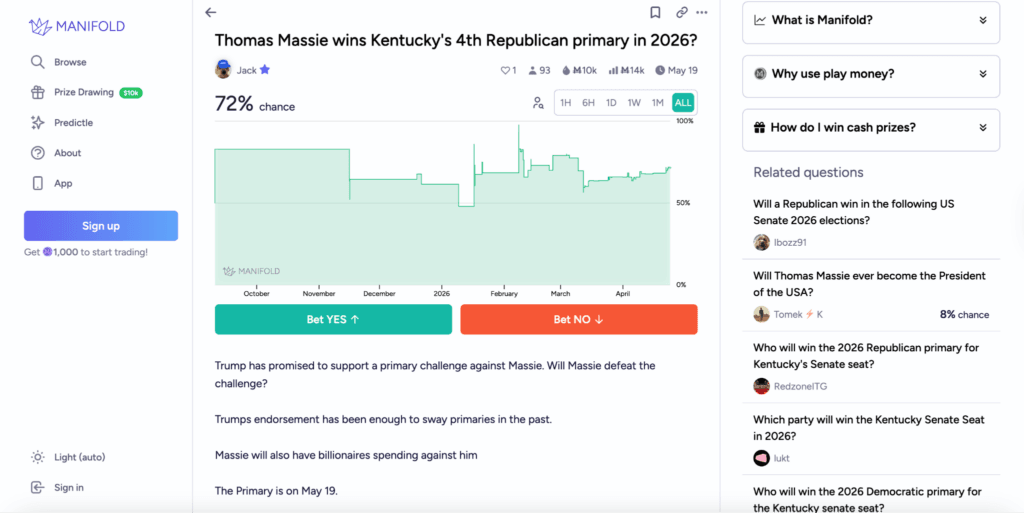
Manifold prediction platform interface.
Manifold is a prediction market that uses the currency “Mana” instead of money.
On the other hand, Manifold has no financial value, so it cannot be regarded as a financial asset; however, it can be used to conduct business through USDC transactions.
However, Manifold allows betting on many topics far broader than just toys. People discuss anything on the platform, from scientific discoveries to movies to politics; events would probably never take place at such sites in places that cannot even be mentioned.
Nevertheless, these results were incredibly precise despite the absence of financial motivation. The matter lies in the very functioning of the market, where the number of participants and the various theories are immense. Such information is invaluable, and Manifold information can be one of the ways to predict future data.
The second benefit is associated with the “sandboxing” method used in knowledge and skills testing. With such an option, people can try various approaches and assumptions while avoiding risk. To put it differently, such an approach is training for real-world trading.
Metaculus
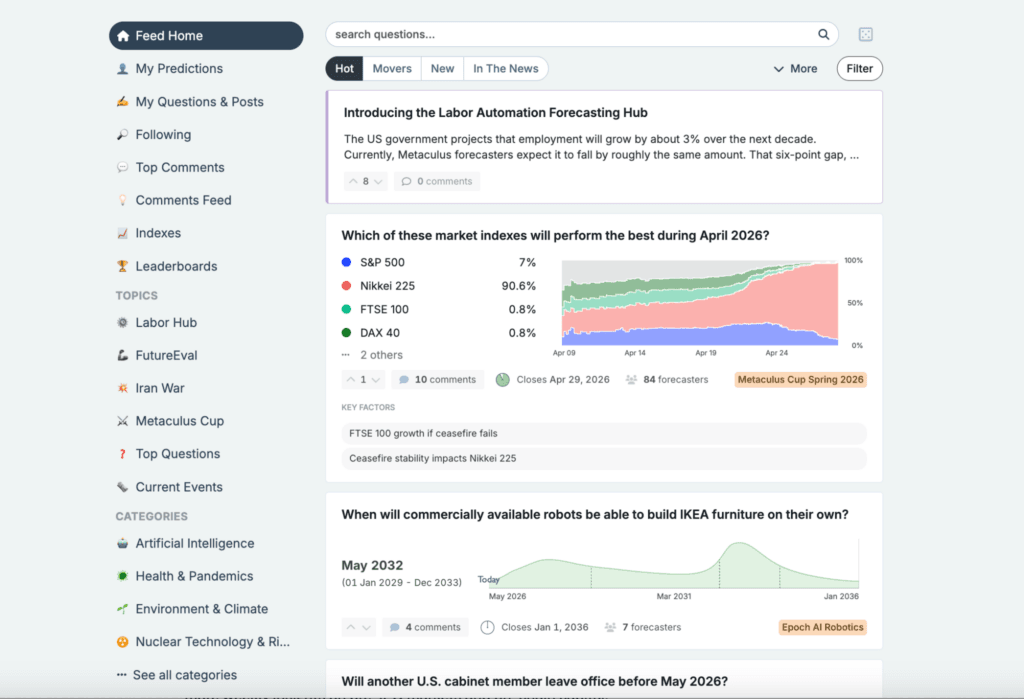
Metaculus prediction platform interface.
Metaculus doesn’t quite fit into the “prediction market” category because it doesn’t involve financial trading. It’s a prediction platform where users submit probability estimates for questions, the results are tracked, and the platform aggregates the community’s predictions into a shared forecast.
But Metaculus deserves a place on this list for one reason: its forecasting is truly exceptional. It attracts subject matter experts, researchers, and serious forecasters who prioritize calibration over entertainment.
The questions on Metaculus span years into the future. AI development timelines, pandemic preparedness rates, geopolitical conflict probabilities, and the pace of scientific reproducibility. These are the kinds of slow-moving but important issues that financial prediction markets don’t address because they can’t trade quickly.
Who it’s for
If you use prediction markets to gain insights into what informed people actually think about the likelihood of a given outcome, Metaculus is one of the best sources available. If you use prediction markets to make money, Metaculus is not the right tool for you.
Consider it a research resource that complements your trading platforms. Before trading the same topic on Polymarket, it’s worth checking the Metaculus community’s forecast on an important geopolitical issue to get a more accurate view from the expert community.
Hedgehog markets
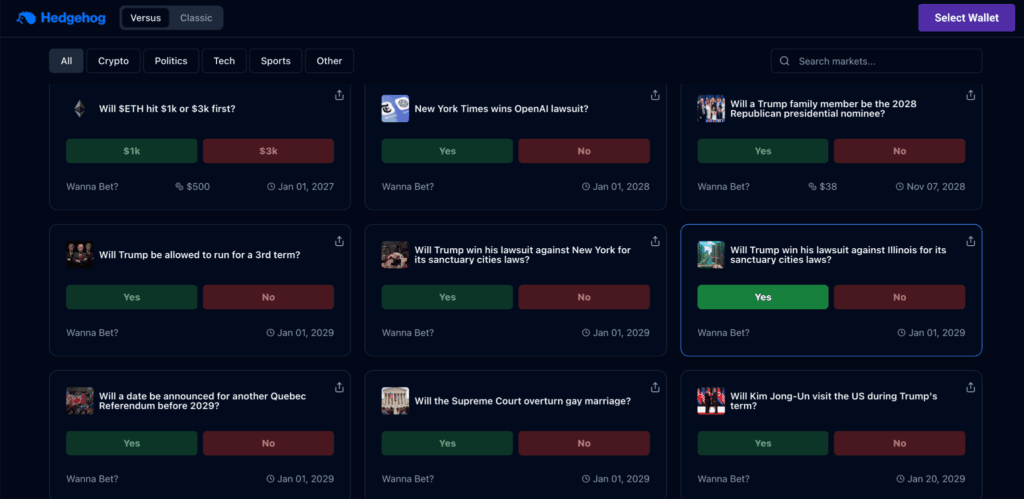
Hedgehog prediction platform interface.
Hedgehog is a decentralized prediction market platform that operates using blockchain metrics instead of the classic prediction markets (“elections/sports”). This means that instead of making predictions related to some external event, such as an election, a sports game result, etc., the user makes bets concerning the blockchain metrics themselves, which include gas, network congestion, MEV, transactions cost increase, etc.
In other words, with Hedgehog, we get the prediction market built directly into the blockchain itself. The trader can place his bet on “Tomorrow, the average Ethereum gas will be higher than 50 GWEI” or “The average network fee will rise by more than 30 percent during the next period”, receiving a price for his actions and the opportunity to hedge himself against potential losses, whereas developers of any projects can use this price signal to their advantage.
The Hedgehog protocol is modular in nature, meaning any on-chain metrics related to fees, network loads, or even individual Layer 2s may be sold under the same roof. This would translate into a steady stream of contracts for users, as the betting opportunities come in a form of small UP/DOWN options expiring at different intervals.
This would be interesting to:
- Speculators, interested not in news-based betting, but in variables related to blockchain infrastructure (such as network load, fees, MEV spikes);
- Projects and protocols, who wish to hedge risks related to their operating costs and gauge the sentiment around their blockchain;
- Research and development organizations, seeking signals regarding the demand for network capacity.
While Polymarket and Kalshi offer bets “on what will happen in the world”, Hedgehog offers bets “on how the blockchain works”.
Final thoughts
The prediction market in 2026 looks completely different than it did three years ago. Clearer regulation in the US, more developed blockchain infrastructure, and the attention generated by the 2024 election cycle have elevated this category to a whole new level of legitimacy and liquidity.
The platforms that will survive and grow will be those that solve the core problem: sufficient decentralization to be censorship-resistant and trustless, and sufficient ease of use to attract liquidity beyond the crypto audience.
Polymarket has attracted attention, but maintaining it is another matter. Other platforms are hot on its heels, opening up a vast field for arbitrage. We’ll know the outcome in 5-10 years. In the meantime, choose a platform that meets your real-world needs.