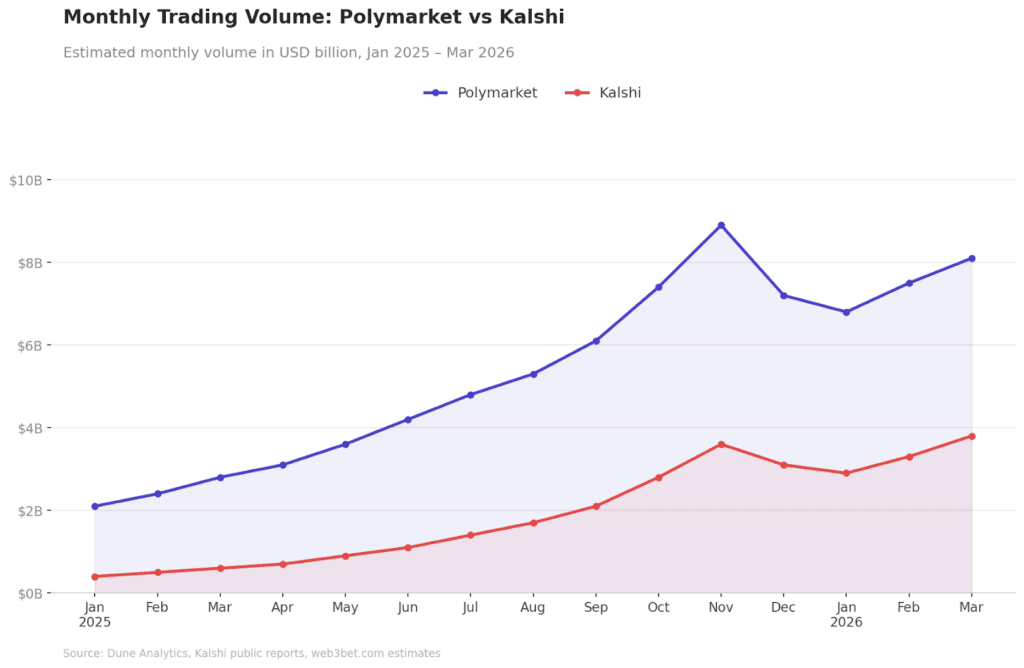
Prediction markets are no longer a niche topic for geeks. At the end of 2025, the two platforms combined generated nearly $12 billion in monthly trading volume. Kalshi and Polimarket together hold nearly 80% of the total market share, and one of the most exciting battles in the betting industry is currently unfolding between them.
But here’s the thing: many perceive them as practically the same thing. They say they’re both about predictions, both about money. But what’s the difference anyway? There is a difference, and a fundamental one at that.
In this article review, we’ve summarized the seven main differences that really matter when choosing a platform.
1. Regulation: The Biggest Divide of All
Kalshi is an exchange governed by federal regulation. It is a DCM and governed by the U.S. CFTC, which regulates other futures exchanges such as CME. Your money will be safeguarded at a regulated clearinghouse, with legal protections in place in the event of any issues. This is particularly crucial for Americans.
Polymarket has no governing bodies because it is decentralized. Polymarket runs on the Polygon network, meaning all transactions occur within smart contracts rather than a regulated financial institution. No governing body controls your USDC; it is stored in your personal wallet. Americans were banned from using the exchange under the 2022 settlement agreement with the CFTC, which required them to do so before the end of 2025. The new government’s policy changes have reopened the door for Americans to trade on the exchange again.
Neither approach is wrong. But they cater to very different types of traders. If you need regulatory protection, tax clarity, and the security of a well-established legal system, Kalshi is your choice. If you’re looking for decentralization, anonymity, and no intermediaries between you and your situation, Polymarket is the way to go. But be careful, regulations change quickly, and even here, there are no 100% guarantees.
2. Deposit: How You Actually Put Money In and Out
However, from a deeper perspective, the two differ greatly in terms of the payment methods they support.
Although Kalshi allows payments using ACH transfers, debit cards, and cryptocurrencies, the only drawback of cryptocurrencies is that they are immediately exchanged for US dollars. All transactions on Kalshi will be carried out in dollars, from deposits to your positions and even to your profits. Withdrawals are made using ACH to your bank account.
You can deposit via:
- ACH bank transfer (1–3 business days)
- Debit card (faster, but fees apply)
- Crypto via Zero Hash converted to USD on arrival
Polymarket operates purely using cryptocurrency. Once you’ve deposited USDC into your non-custodial wallet, you’re able to link it to the exchange. Your funds will be in your wallet until you make any trades.
Deposit methods include:
- Apple Pay, Revolut Pay, Google Play, PayPal;
- USDC via Polygon network (seconds, cents in gas fees);
- ETH or other tokens via bridge (converted to USDC automatically);
- Credit/debit card via onramp providers like Moonpay or Stripe (directly to USDC).
The problem is not how many deposits one needs, but rather the speed and safety of the money’s custody. In the case of Kalshi, for instance, the process is just like that of a brokerage firm. Deposits go in, and your money stays in the firm’s vault until you request withdrawals. Polymarket is akin to a decentralized exchange, as traders’ funds remain in their wallets at all times.
This implies that if there is a trading opportunity on Polymarket at 11 PM Sunday, the trader can easily deposit and execute trades.
3. Market Selection: Breadth vs Depth
Both platforms offer extensive coverage of political issues, economic factors, and other global developments; however, the criteria they use to select which events to highlight differ significantly.
For instance, on the Kalshi platform, newsworthy events are those whose facts and outcomes can be determined in accordance with its policies and regulations. Economic, sporting, weather, and calamity events tend to be backed by evidence, and a decision made on such an event can be either corrected or entirely overturned; for instance, the murder of Iranian leader Khamenei.
Polymarket takes a more liberal approach, as it isn’t subject to regulations when launching markets. Therefore, the topics covered by Polymarket can be quite broad and inventive, as anything can be covered as long as it passes community scrutiny and doesn’t violate any laws in the user’s chosen jurisdiction.
Users can create their own markets, adding variety and unpredictability to the platform’s catalog.
However, the drawback is that Polymarket’s markets sometimes settle in a way that users don’t really agree on. Moreover, there have been cases in which the UMA oracle used to settle disputes has faced criticism for being unfair.
4. The Trading Experience
Kalshi has the feel of a fintech app from the future. Sleek UI design, mobile-first layout, limit orders, market orders, and a readable order book. If you have ever used Robinhood or another retail broker, Kalshi will seem very familiar. It caters to individuals who may not be native to the crypto world.
Polymarket has made tremendous progress since its inception, but retains the essence of a Web3 product. To use it, you require a cryptocurrency wallet. If you have never used a crypto wallet, such as MetaMask, you will find it harder to get started with Polymarket. Onboarding a friend who is not familiar with crypto to Polymarket takes significantly more effort than Kalshi.
That said, Polymarket’s interface for trading, browsing, analyzing probability charts, and placing positions is genuinely good in 2026. The platform has invested heavily in making the experience less intimidating. But the wallet requirement will remain a barrier for the less crypto-savvy for the foreseeable future.
For a mainstream audience, Kalshi is the easier entry point. For crypto-native traders, Polymarket feels more natural.
5. Fees and Costs
Polymarket used to be completely free. That’s no longer true. Starting in early 2026, the platform rolled out taker fees across most market categories. The structure is dynamic; the fee is highest when the market is priced at 50¢ (a true coin flip) and drops toward zero at the extremes.
As for 2026, the peak taker fees on Polymarket by category look like this:
- Crypto markets – 1.80%
- Economics – 1.50%
- Politics – 1.00%
- Finance – 1.00%
- Sports – 0.75%
- Geopolitics – 0% (permanently free)
US traders on Polymarket’s regulated exchange pay a flat 0.30% taker fee with a 0.20% maker rebate. Deposits and withdrawals remain free on both versions of the platform.
There is one key thing to remember here: these fees apply only to takers who remove liquidity from the system via market orders. If you use a limit order and it gets filled, you become a maker and pay no fees. Indeed, 100% of taker fees collected will be paid out as rebates to makers. This design is intended to encourage liquidity providers.
The platform takes fees from winning trades, charging an average fee of 1.2% per contract traded, with a maximum of 1.75% at a 50% probability. Kalshi’s fee differs from Polymarket’s in that it is charged from your winnings, so losing trades won’t cost you anything.
But practically speaking, for the majority of trade amounts and categories, Polymarket will remain relatively more affordable than Kalshi. This becomes especially obvious in trades at 50/50 odds, which cost about 175 times as much with Kalshi as with Polymarket, measured in dollars per the US exchange rate. Yahoo Finance. The only instance in which the costs for both platforms become comparable is when you trade contracts with extremely high or extremely low probability ($0.95 or above or $0.05 or below).
It is important to know that there is another fee to consider when using Polymarket. That would be the bid-ask spread, which is usually minimal in a liquid market but can significantly affect your transactions in a thin market, especially for a niche asset.
6. Privacy and Identity
The KYC process on Kalshi is mandatory. Name, address, ID, sometimes a selfie. These are all necessary and mandatory because Kalshi is a regulated US exchange required by law to adhere to anti-money laundering and know-your-customer policies. All of your trading activities will be linked back to you.
No KYC verification on Polymarket. Simply connect your wallet and trade away. Your name, ID, and email address are not required to participate in the markets. The Polymarket platform offers email signing up for convenience, but again, not necessarily to verify your identity. Your activities on Polymarket are pseudonymous; visible to everyone on the blockchain, but not directly linked to your real-life identity.
This difference may have huge implications for traders from countries where prediction market operations are in a legal grey zone, or even for individuals who just value their financial privacy. The ability to operate pseudonymously on Polymarket helped it grow into a truly international platform.
7. Who Each Platform Is Actually Built For
Put everything above together, and two clear user profiles emerge:
Kalshi caters to the average trader who requires a system that is not only regulated but also conventional, using dollars as its currency. The trader who pays his taxes diligently and seeks to keep all of his transactions in order. The trader who values institutions and benefits from the safety provided by regulation. A trader who prioritizes clarity over convenience.
Polymarket caters to the cryptocurrency-savvy trader who prizes decentralization, speed, and the use of wallets and blockchain technologies. The trader who is willing to operate in an unregulated environment. The trader who desires to enter into a broad set of markets around the world, regardless of location.
Neither platform is objectively better. They’re different tools for different types of people and tasks.
So Which One Should You Use?
Here’s the blunt truth: It all boils down to three variables.
Location: If you’re within the United States and value legal clarity, Kalshi is definitely the platform you should be using. If you’re in another country or an area where regulated platforms aren’t available, Polymarket is probably a better choice.
Money management: Do you store your funds in a bank account and use them to purchase dollars? Then using Kalshi is easy. But if you have cryptocurrency like USDC, Polymarket might work better for you.
Interests: If you’re interested in trading US markets, including politics and economics, Kalshi is the go-to choice, as it offers an extensive range of events. If you prefer other global markets, then Polymarket is the place to be.
It’s common to see people who trade prediction markets use both sites. Kalshi for regulated US markets, and Polymarket for the rest.
The world of prediction markets is changing rapidly, and major players are facing stiff competition. Platforms are developing new products, expanding market catalogs, and competing for the same pool of serious users. Come 2026, and this competition is helping them grow better each day.