Polymarket is the market where almost everyone can be considered “anonymous.” For new users, the platform generates new wallets and acts as a “custodian.” Inside trading occurs everywhere, yet despite its obvious need for prevention, it is still rather inefficient. Thus, the only way to learn about profitable people who have been making money consistently is to analyze on-chain data and analytics.
This article will discuss five successful traders with unique trading methods. However, this is not a list of traders to copy, but a review of their strategies that enable them to benefit from prediction markets.
Note: There is no universal approach here. The market evolves, yet some fundamental aspects, such as working with probabilities, risk management, and detecting inefficiencies, remain unchanged.
Let’s take a look at the most interesting ones!
How these five made the cut
On the Polymarket platform, all trades, positions, and corresponding profits/losses are stored on the Polygon blockchain and are available for anyone to analyze. On paper, this should make the market highly transparent, but in reality, this is far from the case – the information exists, but it is scattered and fragmented.
In recent years, a community-driven analytics system has been developed for Polymarket: tracking large wallets and trade histories on dedicated dashboards, where users manually monitor and compare addresses with results. At this intersection, one can get closer to the truth.
This list includes traders who possess all of the following qualities simultaneously:
- they make money consistently based on blockchain data, not just on a single successful trade;
- They are regularly mentioned on crypto Twitter and in Polymarket circles as people with deep market knowledge.
- In some cases, they explain their reasoning publicly, allowing one to evaluate not only the results but also their thought process.
The key factor here is consistency. There are no “insiders” here who managed to win bets with tenfold odds. That’s not what we’re talking about today. Here we see traders demonstrating their consistency in their actions: entry principles, probabilistic thinking, and risk management.
This is the difference between a real advantage and luck.
1. Car (@Car)
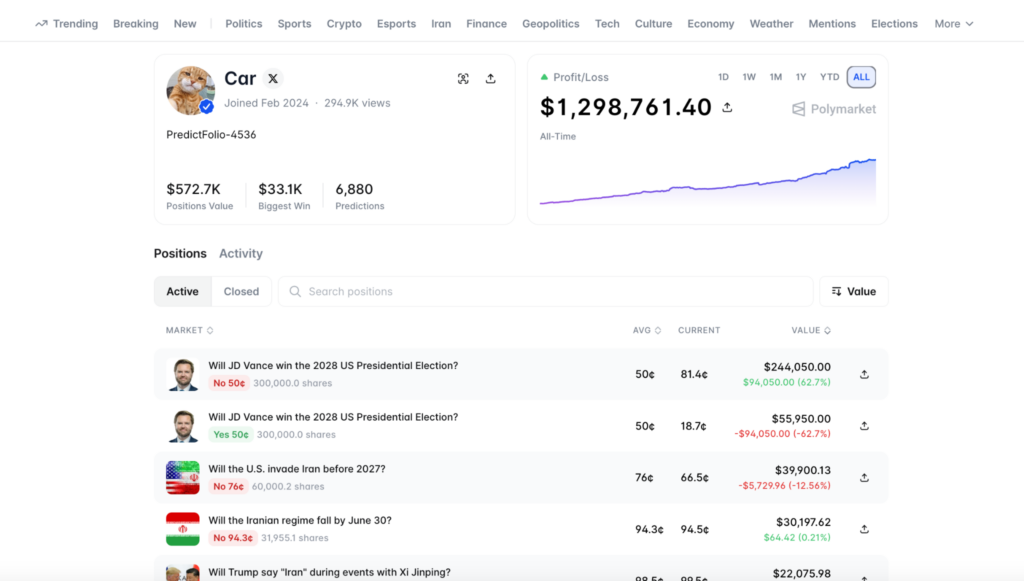
@Сar blew up the market in 2024 when he built a massive position in support of Trump while much of the internet still believed the polls. The scale was large enough to capture widespread public attention and spark endless debate about whether he was ahead of the curve, crazy, or both. People called it manipulation, insider information, all the usual. Then the market shifted in his favor.
In reality, he made a fairly simple conceptual decision, but a very complex emotional one: he decided that the poll-based models everyone was clinging to were structurally flawed, grounded his conviction in it, and bet several million dollars accordingly. He didn’t just “feel” Trump would win; he had a specific theory about why the model the market was using didn’t work.
His distinctive feature is that he observes how the crowd reacts to the “whale’s” words. You can often see him in the comments discussing a positive outcome, but the very next morning, he’ll take the exact opposite view. His position will shift from “yes” to “no” quickly, and he’ll emerge with a huge profit.
His tactic of not sticking to one position but navigating the current has brought him good profits, as shown on the chart.
2. SwissDontMiss (@SwissDontMiss)
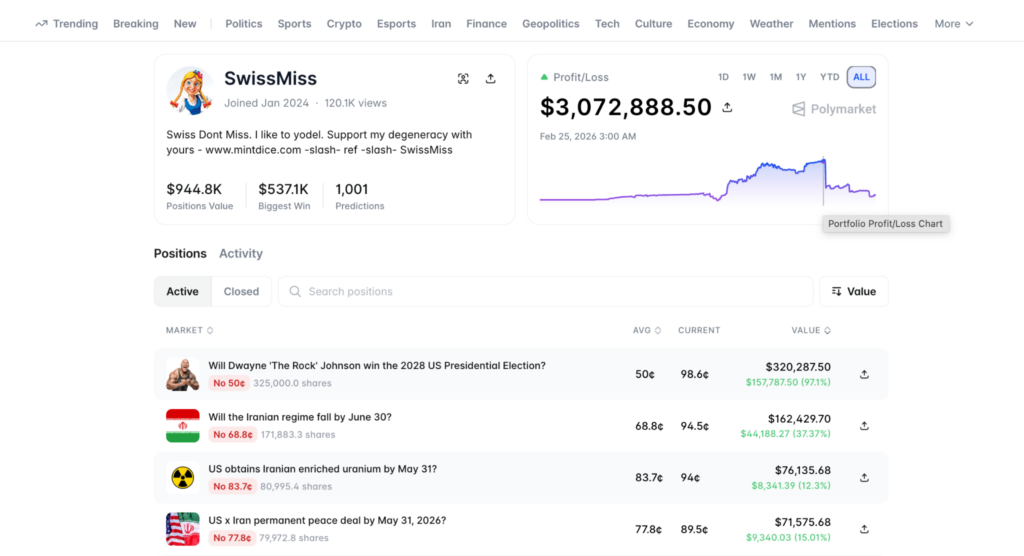
Someone who actually demonstrates their mathematical calculations. It’s still unclear who’s behind this username, a guy or a girl?
SwissDontMiss is perhaps one of the rare Polymarket traders who doesn’t simply celebrate his successes but publicly explains his methodology. Over time, this has attracted an audience of people who want to see the mindset of a trader who uses systematic market forecasts, not just what they click on.
This trader’s style is very similar to “build a model first, then look at the market.” He starts with basic indicators, historical data, expert forecasts, and structured thinking. Based on this, he derives his own probability of a given event. Only then does he look at what Polymarket is pricing in. If the gap between his numbers and the market is large enough, he makes a trade; if it’s small, he abandons it.
He gravitates toward markets where real data is available, but most traders don’t want to spend the time to properly process it: macroeconomic indicators, political decisions, regulatory actions, anything where there’s a flow of information but no rigorous modeling.
The main thing worth borrowing from SwissDontMiss isn’t his specific forecasts, but his discipline: he determines his position size based on the magnitude of the price discrepancy. He makes large bets only when his figure and the market price differ significantly, and smaller ones when the difference is small. In practice, this is essentially “Kelly’s brainstorming,” not “going all in because I have a feeling.”
But even such a trader makes critical mistakes, as exemplified by Trump’s strike on Iran. Many at the time believed that Trump wouldn’t strike Iran or assassinate Khamenei. SwissDontMiss bet a fairly large sum (over $1 million) on “no,” and after the strike, the position simply lost.
So, the tactic of buying almost guaranteed outcomes at 90-99 cents to get a guaranteed $1-$10 after the market closes doesn’t always work, and you could lose your entire deposit. This trader’s example proves this.
3. swisstony (@swisstony)
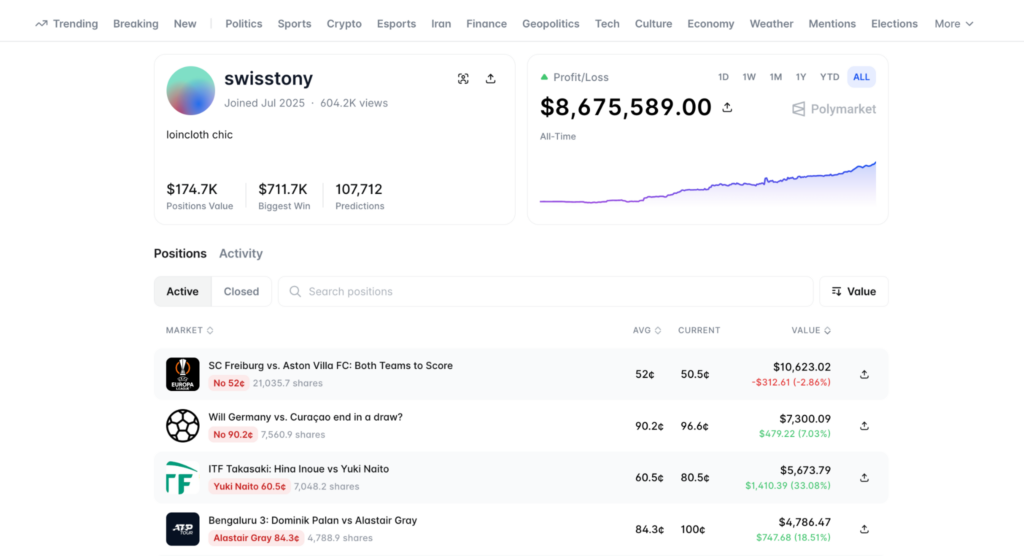
@swisstony is essentially a bot that plays positions in real time.
Swisstony is not a classic “manual” trader, but rather a specialized algorithmic trader for sports markets that exploits a delay in the viewer’s perception of reality through broadcasting.
As seen from on-chain analytics and research, the wallet earned millions of dollars using the broadcast delay effect – the bot receives information about the game directly (API feed + stadium feed), and trades for several seconds in the “future mode” compared to regular viewers and the market.
This kind of trading is called “reality arbitrage”:
- An event happens in reality;
- The bot receives information about the event almost immediately;
- Polymarket receives information about the event only after it is broadcast on TV or streamed.
- During this time delta, the bot can make transactions at the old price and earn millions.
It should be noted that this is the essence of the “infrastructure versus the masses” trading type, and not “better at calculating probabilities.” This approach is completely unattainable for the average retail trader without the infrastructure, but it is the direction prediction markets can take you.
Is it legal? Essentially, yes; it uses classic arbitrage, and there is no “insider” trading.
4. Gamblingisallyouneed (@gamblingisallyouneed)
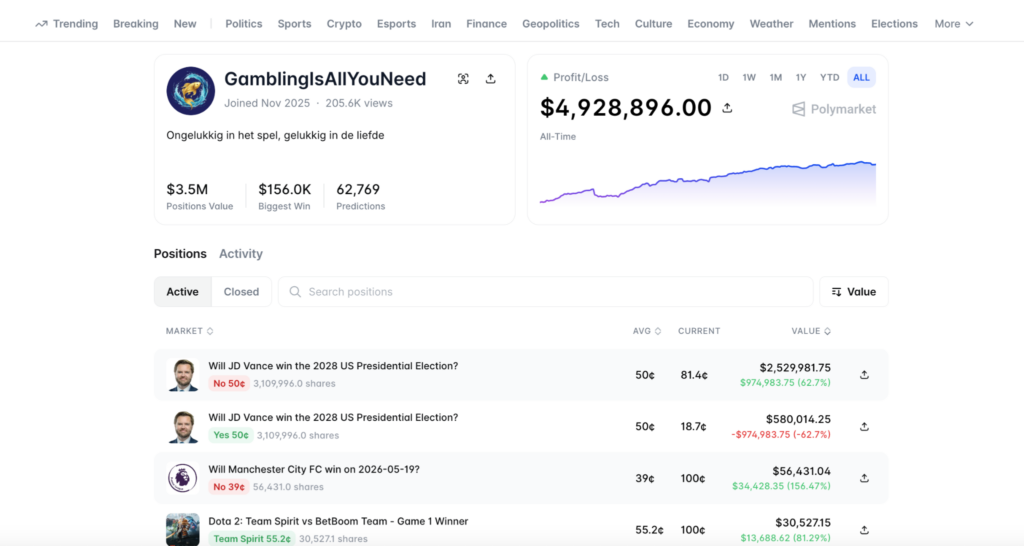
Another one of the most active and successful traders in Polymarket is GamblingIsAllYouNeed. He is a trader mainly focused on sports markets. Based on Polymarket analytics, he earned millions in profit, made tens of thousands of trades, and traded hundreds of millions in total volume. This could be due to multiple wallets.
GamblingIsAllYouNeed stopped being a classical “discreet trader” and now represents a high-frequency trader on the prediction market. Unlike the classical “discreet trader,” he always participates in the market; he does not enter when the market is getting tougher for him. Therefore, his special features are: tens of thousands of transactions (more than 42,000 predictions), about 70% of winners, and many open positions at once. In other words, it does not attempt to “predict the result of the game” but allocates capital between probabilities and prices in a classical trading way.
Based on on-chain behavior and profiles on third-party trackers, it can be said that this wallet acts as a semi-professional market maker, i.e., it permanently tracks the order book, shifts quotes according to the information stream, revalues odds after the publication of news, and catches small price discrepancies between different results, game periods, and time horizons. However, it does not seek out rare, large price discrepancies but systematically captures small ones, replacing an “arbitrage bot.”
5. ImJustKen (@ImJustKen)
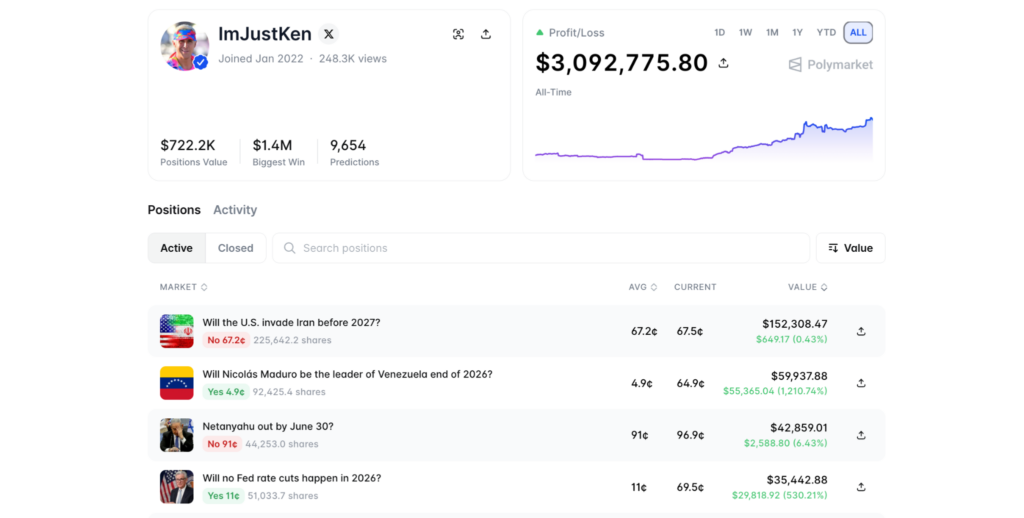
The man operating under the pseudonyms ImJustKen (or Domer) was once a professional poker player and now earns a living through prediction markets. Based on publicly available sources and interviews, he has made around 10,000 predictions and earned between $2.5 and $3 million in net trading profits.
The key factor that determines the strategy of ImJustKen lies in the following principle: regard each market as a slow game of poker. In a poker game, your hand’s value depends on how good it is and how well you position yourself within the game. In the context of prediction markets, instead of positioning, you should consider the quality of your information and research, while the quality of your probabilistic modeling will take the place of your positioning. Just as in a game of poker, the size of your bets will depend on how good your position is and how much money you have available to make the bet.
From the case studies presented, it becomes evident that ImJustKen prefers complicated, “slow” markets, such as politics, geopolitics, macroeconomics, and markets that are rich in news.
For example, he has earned six figures betting against the crowd on Fed picks, the emergence of a full-scale war, or the regime change in Iran.
His attitude towards risk is completely pokerish as well:
He adjusts his bankroll in such a way that even a run of bad luck will not be able to put him out of action.
The size of the position depends on the quality of the edge and not on emotions and the significance of the event itself.
Losses are an integral part of the strategy and represent variance, and not an error.
However, ImJustKen does not present himself as an “organic genius” who can intuitively guess everything. During interviews, he openly states that his main strengths include:
extensive research, a deeper understanding of probabilities compared to the average player, and discipline gained through many years of playing poker. For ImJustKen, political markets are just another table, one that has its own unique features and interface, but still follows mathematical laws.
Discussing him as an example to emulate, ImJustKen can be considered the epitome of “mature money” on Polymarket:
- There are absolutely no cultish “intuitions,”
- A clear understanding of working with probabilities,
- Respect for the bankroll.
But, most importantly, the willingness to exist in a reality where even the best players make mistakes but earn due to mathematics and not luck.
What all five have in common
These traders appear distinct in style, personality, and level of risk-taking aggression. But if you strip away the details, they all share one common trait.
Firstly, each clearly understands their source of advantage and plays to it. For example:
- Car exploits systematic errors in surveys and models, and “manipulates” small-cap markets.
- SwissDontMiss builds its probabilities and compares them with the market (but sometimes makes mistakes).
- GamblingIsAllYouNeed monetizes small edges through volume and infrastructure.
- ImJustKen operates using EV poker logic and calibrated bets.
- Swisstony uses classic arbitrage between events and “beats the markets.”
Secondly, they flexibly manage their position size. They bet not “on the fly,” but proportionally to the strength of the edge: big only where the advantage is truly large.
Medium or small when the signal is weaker. And zero when there’s no advantage at all.
This principle alone separates them from most retail traders, who bet equally on everything and go all-in.
Thirdly, they’re okay with losing trades.
Everyone has noticeable drawdowns and losing markets, but they judge themselves not by a single trade, but by their expected return over time.
Finally, they don’t trade many things. They don’t try to play every market on the main market; they don’t enter markets where the information is obviously one-sided; and they calmly ignore situations where they don’t see an advantage.
The dumbest way to apply all of the above is to try to copy their trades from other people’s dashboards or social media posts. But remember, they’re “whales” and can manage volumes, getting the most favorable prices for themselves. Can you do that? If not, then be extremely careful and manage your “deposit” wisely.