How Polymarket Became a New Kind of Investment Playground


Why Trust Web3Bet
Our team of experts has independently reviewed and evaluated all the products and services featured on this page to ensure you receive accurate and reliable information
In 2020, Polymarket looked like a very interesting platform with a niche audience. A small on-chain platform where crypto-native people bet on news events using USDC. A handful of markets with a total volume in the millions, not the billions. It was the kind of project you might see on Crypto Twitter once, think “this is clever”, and then forget about while you chased the next DeFi farming or airdrop like Arbitrium.
By late 2024, that picture was gone.
Polymarket was processing over $3 billion in monthly volume. Mainstream media were citing its odds alongside (and sometimes instead of) polling aggregators. Traders who had never touched crypto for anything other than token speculation were suddenly opening positions on elections, interest rate decisions, and geopolitical events. It had quietly crossed the line from “weird side product of DeFi” into “new kind of market people take seriously”.
The volume numbers started to impress big media, and big hype about elections did good PR for this platform, which everyone now knows about. So let’s dive deep!
The Credibility Moment: 2024 Elections
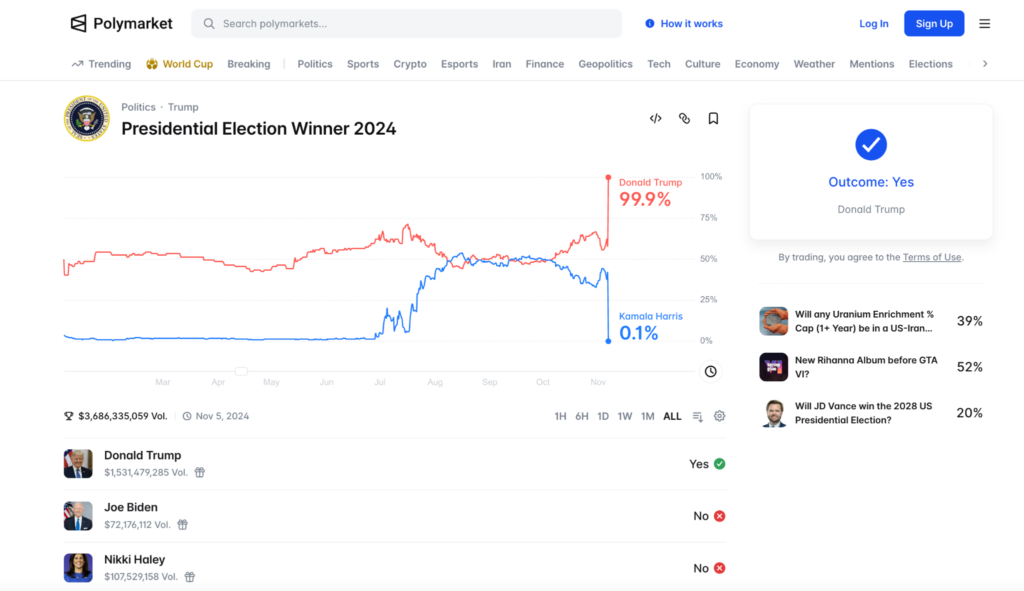
The 2024 US presidential election results: Donald Trump wins by a narrow margin.
For most people, Polymarket didn’t officially exist until one specific event: the 2024 US presidential election.
Poll aggregators, including government-run polls, showed Trump and Harris in a near-dead heat. Depending on which outlet you followed, the margin was small enough to justify any version of events you wanted.
On Polymarket, this wasn’t the case. In the weeks leading up to the election, Trump’s contract traded in the 60-70% range. Traders were betting real money that the election outcome wasn’t a coin flip. It wasn’t a poll reflecting what people thought would happen. It was a real-time price representing what they were willing to bet their capital on.
When the election unfolded as Polymarket predicted, the retrospective coverage followed immediately:
“Prediction markets predicted the outcome, but polls didn’t.”
No market “predicted” anything with certainty. But the media hyped it up differently, and the simple version worked, reaching millions of people who had never heard of Polymarket before that week.
The platform immediately gained recognition: traffic and volumes grew. New users emerged who weren’t part of the typical crypto audience: politically active individuals, journalists, TradeFi professionals, and curious observers eager to see a market that had just surpassed their usual sources of information.
The Product That Kept Them
Most platforms experience a surge in activity during major events, then return to baseline levels. People come for one thing, consume it, and then leave. But Polymarket didn’t. The team was able to maintain interest in the product and, moreover, capture a huge share of the new market.
The reason is simple and structural: by the time the 2024 election wave began, the platform had ceased to be just “that place with prediction markets.” It had transformed into a broad prediction infrastructure with in-depth analysis of various categories.
A user who came to bet on the presidential election found interesting bets (the hottest ones):
– Active prediction markets for Fed decisions;
– Bitcoin and Ethereum price ranges for specific dates;
– Macroeconomic data (CPI, unemployment) as tradable events;
– Sports markets with significant liquidity
– Geopolitical and election results, political decisions, conflicts, and much more.
So, a new user would come in to check the elections, see that there was already a prediction market for the next indicator, and, realizing they had an opinion on that too, open a position. They would then repeat the process with other markets. The platform had enough “surface” that you wouldn’t have to leave after just one bet, awakening the “inner gambler” in you, even if you’d never bet before.
This is important for user retention. A one-time spike is great for raising awareness, but you’ll only retain people in the long term if your product fits into their current mental model of how they track the world. By the end of 2024, Polymarket had achieved this.
Systematic Trader’s Money Came
The 2024 wave of attention also attracted a new type of Polymarket user that had previously been virtually nonexistent: systematic traders from traditional markets.
People who had spent years working in bond, options, and quantitative markets looked at Polymarket and saw something familiar:
- Markets lagging fundamental information;
- Prices tied to noisy signals (polls, headlines);
- Contracts on events that were structurally mispriced because few people were paying attention yet.
In other words: inefficiencies. The same kind of inefficiencies that systematic traders spend their entire careers exploiting in the S&P, FX, or interest rate markets were present on Polymarket, but with far fewer experienced participants.
The first quantitative analysts and market structuring specialists noticed the following patterns:
Political markets overreacted to the results of individual polls; economic data markets were slow to adjust after official releases; Markets, heavily dependent on sentiment, overreacted to emotions and then reverted to the mean.
For system traders, this looked like a market where the competitive curve was much flatter than in fully mature traditional markets. The advantage wasn’t automatic, but it was more accessible. As more money flowed in, some of the simplest advantages were compressed. Prices began to react more quickly.
Why It Doesn’t Just Feel Like Gambling
Traditional betting especially sports betting is structurally zero-sum with a house edge on top. You’re playing against a bookmaker that sets the odds, takes a cut, and often adjusts lines in ways retail rarely sees coming. The expected value is negative for most participants by design.
Prediction markets tweak the structure.
Yes, most participants still lose money over time. That’s just how markets work when many independent actors trade against each other. But what’s happening on Polymarket is not just betting on things. It’s the creation of an information stream.
Prices on Polymarket:
- Encode the collective beliefs of traders with skin in the game
- Update quickly when new information arrives
- Can be backtested against actual outcomes to see which categories are more reliable
Political scientists, economists, journalists, and even casual observers have started using Polymarket prices as one input into their view of the world, not because it’s magic, but because it often moves faster and integrates more diverse information than conventional media.
The financial reality for the average trader hasn’t changed. Many will lose and some will win. A few will build durable edge but the reason people engage can be very different and that’s where it stops being “just gambling”.
The Regulatory Wall They’re Running At
By 2026, Polymarket’s growth story runs into the same hard problem every new financial product eventually faces: regulation.
Under the current US administration, the CFTC has shown more willingness to allow limited prediction market activity, especially when it’s framed as “information markets”. But the line is not clear. Sports-related contracts sit in a gray zone. Markets on certain political events generate scrutiny that standard crypto tokens never face.
The platform’s most popular and attention-driving markets are often political and sports-related. Those are exactly the categories regulators are most wary of.
From Curiosity to Infrastructure
In four years, Polymarket has gone from “crypto-native curiosity” to something closer to infrastructure:
Whatever happens next token launch, IPO path, regulatory tightening, or further expansion the bigger point is simple: prediction markets are not going back into the niche box they came from.
Once you’ve seen a live price on “Will X happen by Y?” outperform a stack of opinion polls, it’s hard to unsee it. And that’s the real transformation Polymarket kicked off: not just more volume, but a new mental habit for how people think about events — as tradable probabilities, not just headlines.