Every prediction market has accounts that other traders follow, debate, and secretly copy. On Polymarket, these aren’t hedge funds or institutional investors; they are mostly anonymous wallets managed by individuals whose identities remain unknown, yet whose profits are enough to make many professional traders envious.
What sets these stories apart from a standard casino jackpot win is that Polymarket bets are tied to real, verifiable events such as elections, sports results, search trends, and geopolitical outcomes. Furthermore, every trade is recorded on a public blockchain, where anyone can track it. It is precisely this transparency that has turned some of these wins into genuine internet phenomena and, in some cases, sparked federal investigations into insider trading.
For this same reason, tracking the moves of Polymarket “whales” has evolved into a mini-industry of its own. Tools like Polygonscan, Dune Analytics dashboards, and third-party services exist to monitor bets that are unusually large or placed with impeccable timing. They are in high demand because the transparency that authenticates these stories also makes it possible to analyze them in real time, sometimes even before the trade has closed.
Below are five of the most incredible examples of rapid capital growth on Polymarket: what these players bet on and what happened once the world found out.
Let’s take a closer look.
1. Théo: The $22 Million Election Bet
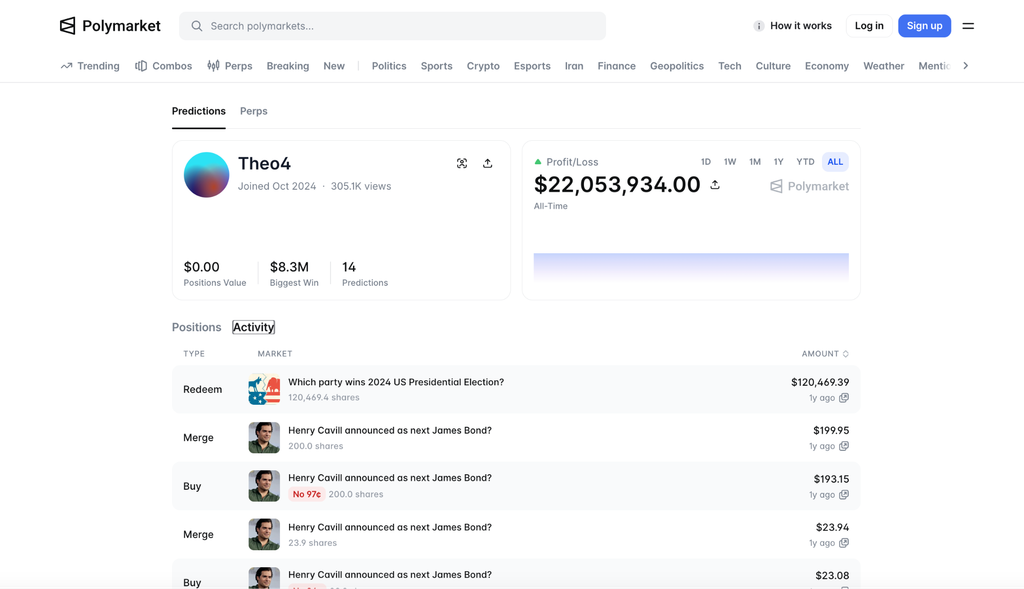
Theo’s account and his market bets.
Kicking off our list is arguably one of the most intriguing players on Polymarket, or rather, a group of crypto wallets (including Fredi9999, Theo4, and PrincessCaro) that all trace back to a single French trader known to the public simply as “Theo.” In October 2024, with polls showing a dead heat between the candidates, Theo decided to take a gamble, collectively wagering around $30 million on a Donald Trump victory in the presidential election.
The market viewed this position as reckless. Poll averages pointed to an unpredictable outcome, and a $30 million bet on a “coin-flip” event seemed to most observers like a surefire way to lose a fortune. When Trump won, the payout on the position totaled approximately $85 million; the analytics firm Chainalysis later tracked the movement of these winnings across eleven different wallets, several of which now hold five of the top 20 spots in Polymarket’s overall rankings.
According to those who later analyzed his methods, Theo differed from the typical lucky gambler in that he didn’t simply bet on Trump. He reportedly organized his own polling system in swing states and purchased data he deemed more accurate than the public aggregates relied upon by other market participants. Regardless, the trade remains the largest publicly recorded win in the history of prediction markets.
Activity from Theo’s wallets did not cease after November 2024. Analysts tracking the cluster observed him re-entering major markets ahead of subsequent elections and key macroeconomic events, treating the $85 million windfall not as a retirement nest egg, but as working capital for new, carefully calculated, and high-conviction bets.
2. AlphaRaccoon: The Google Insider Nobody Could Prove
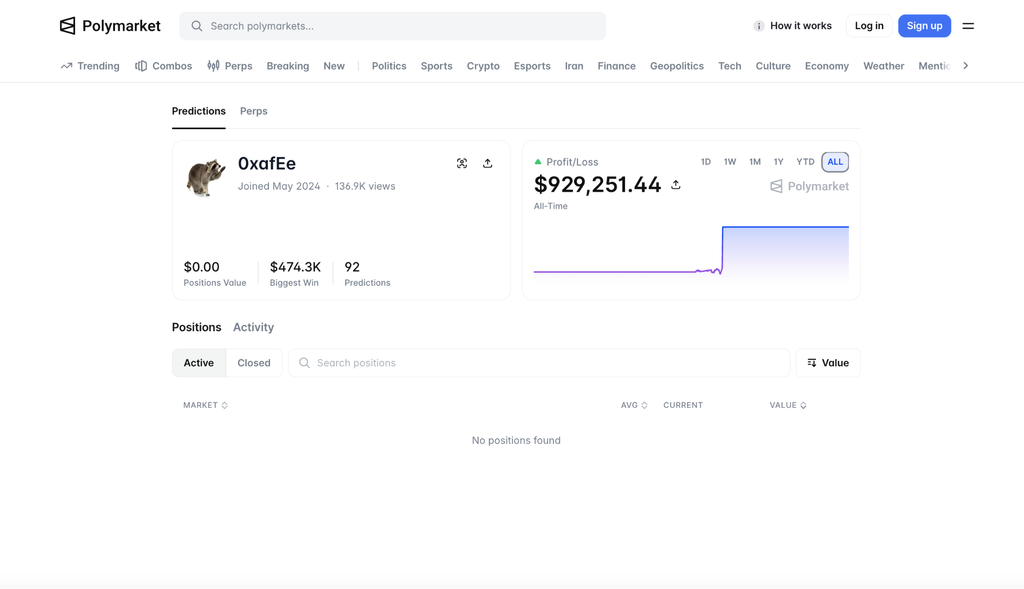
0xafEe, also known as the trader AlphaRaccoon, was identified through investigations.
In December 2025, the Polymarket account “AlphaRaccoon” (later identified on the blockchain as wallet 0xafEe) turned a $10,647 wager on the obscure artist d4vd into nearly $200,000 by betting that the singer would top Google’s “Year in Search” rankings an outcome the market had priced at just 0.2%.
While that bet alone would have made headlines, a genuine scandal erupted over subsequent events: the same account won 22 out of 23 bets on markets linked to highly specific Google search queries. It placed “No” bets against clear favorites such as Pope Leo XIV and Donald Trump moments before Google mistakenly published the actual ranking results prematurely; the total profit for the day approached $1 million. A Meta engineer publicly highlighted this pattern on X, and the community’s reaction was immediate: a consensus emerged that this was not merely luck, but rather a case of someone accessing real data ahead of the market.
Initially, there were no official charges or public confirmation of a link between the trader and Google, and the episode remained a textbook example of information asymmetry in prediction markets. However, the situation changed by May 2026: the account changed its username from “AlphaRaccoon” to the wallet address “0xafEe,” and the U.S. Attorney’s Office for the Southern District of New York filed formal charges against Michele Spagnuolo, a 36-year-old Google information security engineer from Switzerland, for commodities fraud, wire fraud, and money laundering.
According to investigators, Spagnuolo had access to an internal Google tool marked “Google Confidential” containing unpublished “Year in Search 2025” data and placed approximately 25 bets totaling around $2.75 million on Polymarket between October 15 and December 4, 2025, netting a profit of about $1.2 million. His largest positions involved betting against Bianca Censori (~$937,688), Pope Leo XIV (~$613,587), and Trump (~$509,149), specifically betting “no” on the favorites regarding whom he allegedly had advance data. A key piece of evidence was the transfer of approximately $149,980 from the “AlphaRaccoon” wallet to a payment processor account registered in Spagnuolo’s name using an Italian ID document.
It is striking how modest the initial stake ($10,647) was compared to the final outcome; this is an amount within the reach of an ordinary retail trader, not a Polymarket “whale.” The account drew widespread attention precisely because of what happened next: a nearly flawless run of 22 winning bets out of 23 across markets where the outcomes should theoretically have been completely unpredictable.
3. ascetic0x: $12 Into Six Figures on Pure Bitcoin Momentum
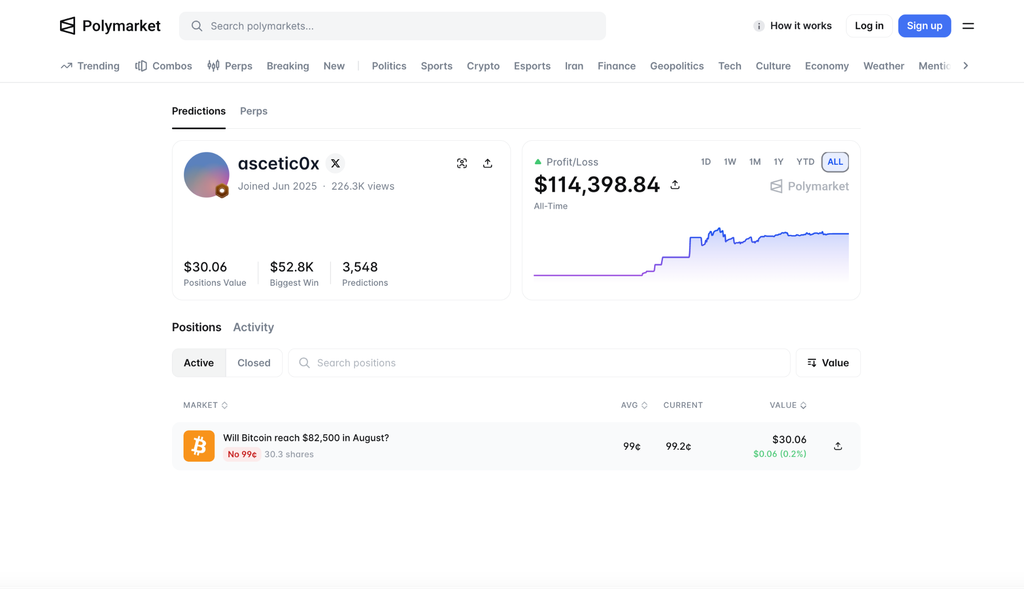
Trader ascetic0x’s account is still in the position (the account is active).
Not every major win on Polymarket stems from insider information or massive capital. In January 2026, a trader using the handle ascetic0x, identifiable on the platform by the wallet address 0xfcbecc7e5186e88e03445b81f593685d62828f44, publicly documented how he turned an initial deposit of just $12 into over $100,000 by going “all-in” on short-term Bitcoin price fluctuations and doubling his capital sixteen times in a row.
The Montreal-based trader shared the rationale behind each bet in real time, a rare instance of transparency for such an impressive string of trades, which largely fueled the story’s widespread popularity. On January 15, 2026, he publicly announced his success on X, writing: “I DID IT!!! Turned $12 into $100,000 (over 8,300x).” Sixteen consecutive correct predictions regarding short-term cryptocurrency price movements represent an extraordinary feat from any statistical standpoint; the decision to stake everything every time rather than scaling back the wager as the balance grew distinguishes this thrilling success story from a replicable strategy, as a single mistake at any stage would have wiped out the account.
This is a classic Polymarket “whale” story: it involves no edge other than unwavering conviction and a willingness to take maximum risk, making for a fascinating read, yet something virtually impossible to replicate responsibly. It is worth considering the math: sixteen all-in bets mean that, in essence, the trader made a choice comparable to a coin toss each time and was right every single time. This should be viewed as entertainment rather than proof of reliable predictability regarding short-term cryptocurrency price movements at such a frequency.
4. swisstony: Grinding to $18 Million, One World Cup Match at a Time
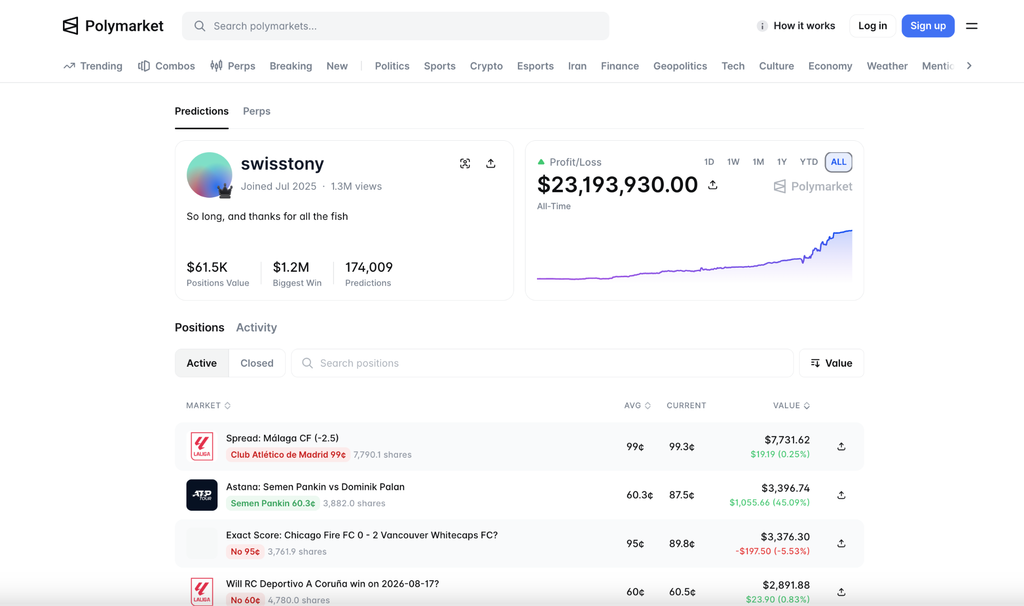
The account of trader @swisstony also remains active and continues to accumulate profit.
Not every “whale” chases a single, all-or-nothing wager. The account holder known as “swisstony” chose a completely different path, opting instead to bet on volume.
Registered in July 2025, the account had placed over 139,000 bets by mid-2026, generating a total profit of $18.62 million (including $10.33 million earned in just one month during the 2026 World Cup).
The strategy relied primarily on betting “against” (the “No” option) overvalued favorites such as Germany, England, and Japan. The market priced their chances higher than swisstony’s own model predicted, with individual stakes often ranging from $400,000 to $1 million. This represents a fundamentally different kind of success story for a high-stakes bettor compared to figures like Théo or AlphaRaccoon: it was not about a single flawless prediction, but rather the application of a statistical edge leveraged hundreds of times over until the cumulative profit reached eight figures.
Reportedly, the account’s page garnered nearly a million views after details of its earnings became public. The player’s active positions at the time the data was gathered still focused on live World Cup matches indicate that the trader is continuing to actively exploit this edge rather than simply resting on their laurels and settling for the profits already secured.
5. The Maduro Bet: $32,000 Into $436,000 in 48 Hours
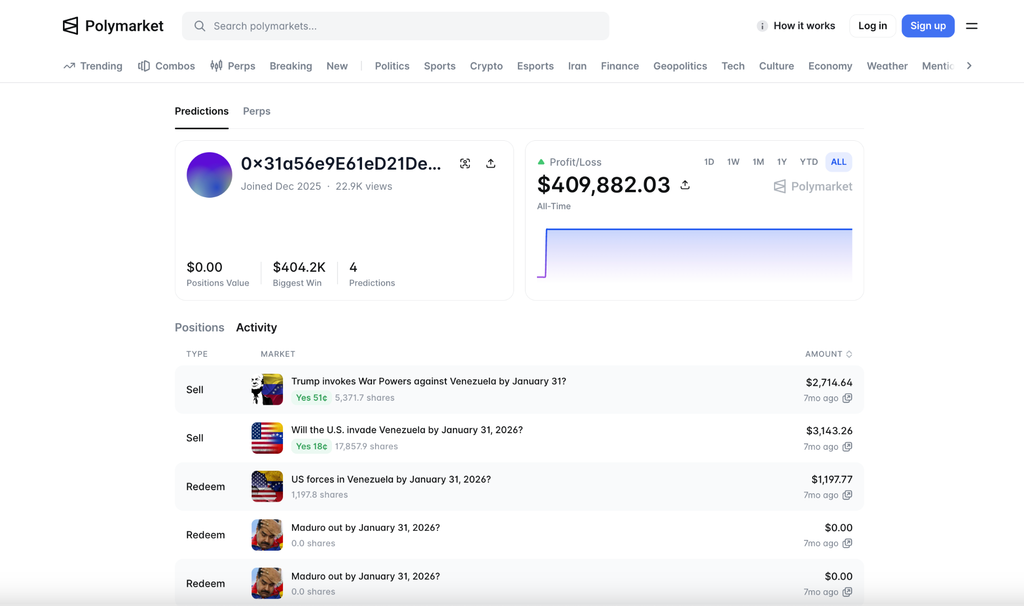
The account of the hapless insider Ken Van Dyke
In early January 2026, the owner of a Polymarket account registered less than a week prior placed a series of thirteen bets totaling approximately $32,000 on Venezuelan President Nicolás Maduro losing power by January 31, even though the platform itself estimated the probability of such an outcome at just 5.5%. When U.S. forces captured Maduro that Saturday during Operation Absolute Resolve, the account holder collected $436,759.61 in winnings.
The story did not end with the payout; the circumstances of the trade a brand-new account, bets placed almost exclusively on Maduro-related events, and the largest, final wagers made just hours before news of the operation went public immediately drew the attention of journalists and financial market reform advocates. Months later, prosecutors charged U.S. Army Special Forces Master Sergeant Gannon Ken Van Dyke, 38, of Fayetteville, North Carolina. He had directly participated in planning and executing the raid to capture Maduro and, according to investigators, used his access to classified information about the operation to place the winning bets. In response, Polymarket announced a partnership with a blockchain analytics firm to continuously monitor the platform for similar suspicious schemes in the future.
Van Dyke’s Polymarket wallet was identified as 0x31a56e9E690c621eD21De08Cb559e9524Cdb8eD9; it invested around $34,000 and generated a profit of approximately $409,900, the largest of the three “insider” positions identified by Lookonchain analysts. Van Dyke himself created the account on December 26, 2025, using a VPN to mask his location; after noticing public attention regarding the suspicious trading, he attempted to delete the account and change the email address linked to the crypto exchange actions taken to cover his tracks, which served as additional evidence against him.
Financial market reform experts who analyzed the trade stated that it bore “all the hallmarks” of insider trading: the size of the position, the extremely late timing of the bets relative to the transaction itself, and the complete absence of any prior betting history on the account.
What These Five Stories Actually Have in Common
Setting aside the details, these success stories fall into three distinct categories that are too often lumped together under the umbrella term “whales.”
Théo and swisstony demonstrate a genuine edge rooted in deep analysis and modeling; they acted with conviction and sound bankroll management. While Théo’s single bet might have appeared reckless to an outsider, ascetic0x represents pure, unadulterated variance akin to flipping a coin and getting the desired result sixteen times in a row. Such a case makes for an interesting story but is practically useless as a replicable strategy. Finally, AlphaRaccoon and the bettor who wagered on Maduro represent the uncomfortable scenario of insider trading a practice that deals a heavy blow to the nascent prediction market.
One must also consider the obvious issue of “survivorship bias”: these five tales are success stories. Independent studies of trading activity indicate that roughly 87% of active Polymarket traders lose money over time. Behind every viral story about a “whale” lie thousands of less visible players who also staked it all but went unnoticed because their positions plummeted in value rather than skyrocketing.
Drawing inspiration from these five stories is one thing, but treating them as a ready-made strategy is quite another and usually a mistake. Even directly copying a famous whale’s trades, mirroring their positions in real-time rather than trying to guess who the next big player will be, typically yields significantly lower returns than the whale achieved themselves.