For the past year, crypto users on Twitter have been discussing how Polymarket traders are building Claude-based bots, connecting them to Polymarket, and literally printing money while everyone else is asleep. Some are sharing screenshots of five-figure profits. Others are selling courses for $497, promising to teach a “secret system” for generating profits practically out of thin air.
In this article, we’ll explore what’s truly working and what’s just clever marketing for other people’s courses. Let’s take a closer look.
Scale and a Few Figures
Before discussing bots, it is necessary to grasp the scale Polymarket has achieved; without this context, any conversation about bots loses its meaning.
In the first eleven months of 2025, Polymarket’s notional trading volume exceeded $22 billion a 57% increase over the total for 2024. By the start of 2026, monthly volumes had surged from approximately $1.2 billion to over $20 billion. The combined trading volume across Polymarket and Kalshi prediction markets topped $40 billion in 2025 alone, and by April 2026, the global prediction market was processing roughly $24 billion in monthly transactions. In effect, the prediction market has become highly liquid and competitive, with institutional players participating increasingly actively.
However, an important caveat is in order. A study by Columbia University revealed that approximately 25% of Polymarket’s trading volume consists of “wash trading,” artificial activity that inflates the reported figures. During certain weeks, particularly at the height of the election campaign, over 90% of trades in specific markets were flagged as suspicious. The “real” market is smaller than official numbers suggest, yet it remains massive, with competition intensifying month by month. Furthermore, an increasing number of platforms are integrating Polymarket to retain users and monetize traffic, earning commissions from Polymarket in the process.
Why does this matter in the context of discussions about bots? When you hear about a bot generating massive profits, you should ask yourself: Is it trading in truly liquid markets, or is it exploiting the platform’s low-liquidity, “thin” segments where even a few hundred dollars can move the price?
What the Most Extreme Claims Actually Describe
Let’s steelman the bull case first, because some of the real numbers are genuinely striking.
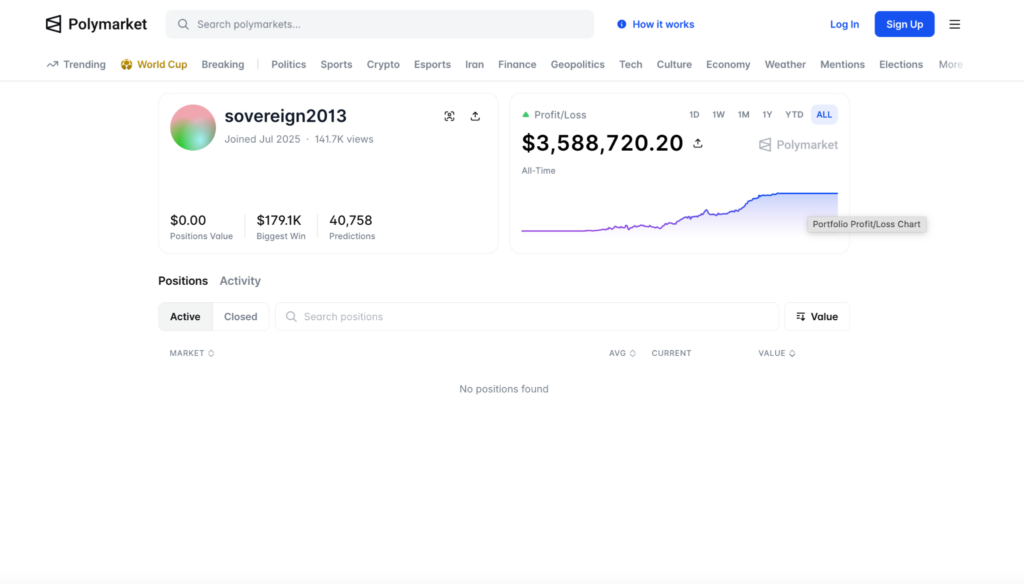
An example of a trading bot that turned a few dollars into hundreds. To stay under the radar after a successful run, they create new accounts, which makes tracking them somewhat more difficult.
Let’s examine a few cases that stand out from the general statistics and demonstrate staggering results.
For instance, reports indicate that a bot powered by the Claude model (account sovereign2013) turned $1 into $3.3 million on Polymarket starting in August 2025, placing bets several times a minute primarily on sports markets. In just one week in early 2026, it generated approximately $416,000 in profit. Another bot reportedly grew its capital from $313 to $414,000 in a single month by trading Bitcoin, Ethereum, and Solana on 15-minute “up/down” prediction markets, boasting a reported 98% success rate.
In another instance, a Chinese student living in Japan allegedly turned $0.90 into $408,292 on Polymarket by trading on 5-minute BTC “up/down” prediction markets. The bot he created using Claude does not attempt to predict Bitcoin’s price movements; instead, it exploits micro-latencies between the following elements:
- Spot price feeds from Binance (via WebSocket);
- TradingView signals cross-referenced with order flow data from CryptoQuant;
- Price update latency in Polymarket’s central limit order book.
The system executes trades in under 100 milliseconds before the order book updates and can send over 1,000 orders per second, capturing a profit of 0.3-0.8% per trade. The advantage here lies not in the ability to predict market direction, but in a structural factor: it is the same type of latency arbitrage that high-frequency trading (HFT) firms have used in traditional markets for 15 years.
The situation with institutional participants is similar: 14 of the 20 most profitable wallets on Polymarket belong to bots. They dominate not because of some AI magic, but because bots do not get tired, hesitate, or become emotionally attached to their trading ideas.
What’s Actually Possible: The Three Archetypes
For the most part, bot operators try to disguise their activities as market making or arbitrage, though this isn’t always the case. In reality, there are three types of bots actively operating on Polymarket:
News monitoring: A bot that automatically scans through RSS feeds, Twitter, and certain news sources looking for specific keywords related to open markets. When such an article appears, the bot evaluates its content and assesses its potential impact on the odds of a “Yes” outcome in a particular market. This has been the most popular and easiest-to-code type of bot to create. Its benefits have to do with the timeliness of the information, not with how accurate its predictions are: you trade ahead of other, slower market participants.
Probabilistic modeling: This bot maintains an up-to-date model for specific market categories (e.g., political events, economic indicators, sports results) and signals when the current Polymarket price deviates significantly from the model’s calculated values. This approach works best in categories with extensive historical data and a stable market structure.
Latency arbitrage: This is the closest equivalent to true automated alpha generation; it is almost certainly the strategy employed by the most profitable bots. The bot identifies correlated markets, such as a national political betting market and a related state-level market, or a sporting event listed on multiple platforms, and executes trades in both directions when the price spread exceeds a certain threshold.
If you are considering building your own bot, start by deciding which type suits you best and what specific tasks you want it to handle.
The Claims That Are Mostly Hype
“My Claude-based bot made $50,000 last month.” While theoretically possible, there is alas no way to verify this. On platforms where users hide behind pseudonyms, faking screenshots is incredibly easy.
“Feed market data to Claude, and it will pick winning assets.” This is the most dangerous misconception of all. Claude is an excellent tool for logical analysis; it excels at summarizing information, identifying patterns, and constructing arguments. However, it cannot consistently predict events more accurately than the market. If simply feeding data into a large language model (LLM) allowed for the reliable identification of mispriced assets, Wall Street’s quantitative funds would have done so long ago, and the advantage would have vanished the moment capital flooded into the niche.
A harsh reality check: in documented trials, a general-purpose AI model operating on predictive signals lost $4,800 over three months. General intelligence is not the same as a trader’s intelligence.
“Full automation, no oversight required.” In the long run, only monitored bots survive. Fully autonomous systems inevitably run into the same problem: they are undone by unexpected news, market manipulation, or sudden liquidity shortages. A human monitoring the system would recognize such a signal as market noise, but a bot cannot make that distinction.
What Claude Is Actually Good At Here
If we strip away the AI hype, three genuine use cases for agents and other AI tools emerge:
Data analysis before opening a position: Suppose you are analyzing the political betting market. You feed Claude two weeks’ worth of polling data, news summaries, Twitter sentiment analysis, and the current market price. Then, you ask it to generate a structured analytical overview: what would a knowledgeable expert say about whether the current price is reasonable? What arguments weigh against your position (a “bearish” scenario)?
What kind of new information could radically alter the picture? This is not merely a chatbot, but a full-fledged research partner. The result is a more considered decision made by the human.
Building infrastructure: Not everyone who wants to create a monitoring system knows how to write Python code from scratch. Claude can do it for you. The journey from idea (“I want a system that tracks Fed statements and notifies me of price changes for relevant Polymarket contracts”) to a working solution takes about 45 minutes of “intuitive programming” (or “vibe-coding”) in tandem with Claude. This significantly lowers the barrier to entry for development.
Stress-testing your hypothesis: Before opening a large position, lay out your reasoning in detail for Claude. Then, ask the AI to argue against you as convincingly as possible. Ask it to identify three assumptions in your hypothesis that are most likely to be flawed. This “steel-manning” exercise, where you consciously seek out and consider the strongest counter-arguments, is more valuable than any research that simply confirms you are right. Yet, most retail traders completely ignore this step because it causes psychological discomfort.
The Honest Bottom Line
The prediction market is growing and becoming increasingly algorithm-driven. Documented cases confirm that Claude-based bots can generate significant returns, while architectures of Anthropic’s caliber demonstrate strong backtesting results.
The competitive edge narrows as professional market makers and institutional capital enter the market. Only narrow niches remain where human contextual understanding surpasses that of algorithms.
This is precisely where it makes sense to develop such bots, which, given the ongoing evolution of AI, will likely become even more popular in the near future.