Polymarket Airdrop Confirmed: $POLY Token Details & Step-by-Step Participation Guide


Why Trust Web3Bet
Our team of experts has independently reviewed and evaluated all the products and services featured on this page to ensure you receive accurate and reliable information
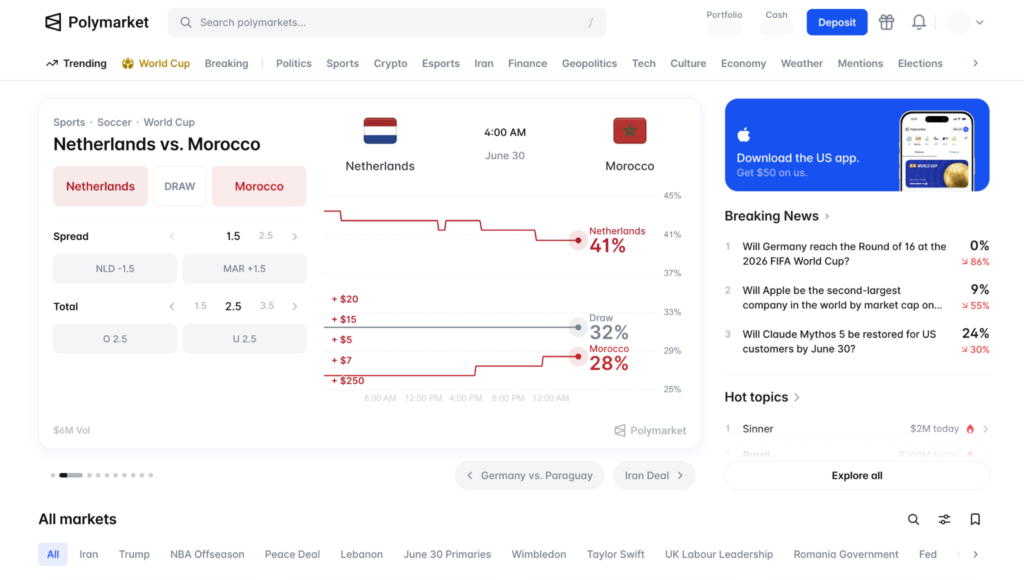
Polymarket Main Page Interface
The crypto community has been discussing a potential Polymarket token for years, and for good reason. The platform processed billions of dollars in volume surrounding the 2024 US presidential election and generated significant trading activity, yet a native token never materialized. For those following the market, the pattern was clear: this wasn’t a platform without a token, but rather a platform that simply hadn’t launched one yet.
The timing makes the speculation harder to ignore. Prediction markets as a category had their breakout moment in 2024–2025: monthly volumes rose from $1.2 billion to over $20 billion, institutional participants entered the market, and Polymarket became a mainstream reference point during every major news cycle. A platform at that scale, with that kind of user base and trading history, sitting on a tokenless infrastructure while competitors move toward tokenization, that’s not an oversight.
Let’s take a look at what is being discussed in chats and on forums, and what we actually know.
What is actually known
As of this writing, there is no official confirmation regarding the launch of the $POLY token. However, several factors speak for themselves: Polymarket is actively hiring for over 50 open positions, including smart contract engineers and legal roles focused on regulated markets, which signals infrastructure scaling rather than a static platform. Additionally, discussions in the official Discord show that team members do not deny plans to tokenize when asked directly, and there is a general pattern of every major prediction market platform eventually tokenizing.
Kalshi is also exploring tokenization, though it will likely be more difficult for them given their heavy reliance on the US market. There is real pressure to grant long-term users ownership in the platform they helped build through their activity.
If the $POLY token launches, the most likely mechanism will involve retroactive rewards for historical users, weighted by trading volume, market-creation activity, and time spent on the platform. Precedents such as Uniswap (UNI), dYdX (DYDX), and Optimism (OP) show that early and active users received the most significant allocations not for a single large deposit, but for consistent activity over time.
Token, IPO, or both
A separate storyline circulating in the community, alongside the airdrop talk, is the possibility that Polymarket may pursue a public listing. The platform has secured venture funding from major firms, and its trading volumes have reached levels that make the company attractive to public markets; furthermore, its overall trajectory spanning revenue growth, media visibility, and institutional interest aligns with a pre-IPO profile.
Speculation occasionally surfaces in crypto media and on Twitter that Polymarket might opt for a hybrid approach: a token for on-chain governance and community ownership combined with a traditional IPO to attract institutional capital. These paths are not mutually exclusive; several major crypto companies have already combined a native token with a public stock listing. Coinbase (with its Base token) serves as an obvious precedent, albeit with a different business model.
If Polymarket does indeed move toward an IPO, trading activity on the platform gains dual value: it serves as a potential basis for an airdrop and represents participation in the company’s growth leading up to its public debut. I recommend keeping an eye on this development independently of the airdrop narrative.
Based on comparable platform tokens such as UMA (the oracle provider used by Polymarket) and similar DeFi-adjacent projects $POLY will likely encompass:
- staking mechanisms;
- governance rights regarding platform decisions;
- fee sharing for active traders exceeding specific volume thresholds;
- and potentially access to exclusive market categories or higher position limits.
None of these features have been officially confirmed. However, this represents the standard token architecture for platforms operating under a similar model.
What to do and how to boost your chances “just in case”: a step-by-step guide
Step 1. Account and Wallet: Create an account on Polymarket and connect a MetaMask or Phantom Web3 wallet. Important: the wallet must be under your control, not an exchange-issued one.
Step 2. Deposit and Trade: Deposit USDC and start trading. Any activity is better than no activity, but volume and stability are more important than a single large position. Regular trading across multiple market categories is a profile that has historically been rewarded in retroactive distributions.
Step 3. Diversify Your Activity: Don’t trade only one category. Politics, crypto markets, economics, sports: broad participation signals genuine engagement with the platform. Distribution algorithms can distinguish this from a single speculative position.
Step 4. Market Making: Providing liquidity to both sides of thin markets generates maker rebates and, based on other platforms’ experience, positively impacts on-chain activity. It requires more capital and a better understanding of the mechanics, but historical data from other distributions suggest it pays off.
Step 5. One Wallet, Real Activity: Don’t create multiple wallets to farm activity or use anti-detect browsers to do so. Detecting sybil activity has become standard in airdrop distributions; platforms use clustering analysis to identify wallets that appear to be a single user split across multiple addresses and exclude them. One real wallet with real activity consistently outperforms ten fake ones in any distribution formula used to date.
Step 6. Follow official channels: For example, X (ex-Twitter) (@Polymarket). Token announcements, when they arrive, typically include a snapshot date for the moment your activity is recorded. Knowing this date in advance allows you to optimize the final period leading up to the snapshot.
Honest risk assessment
Farming airdrops isn’t free money. You need to accumulate real capital, accept real market risk, and pay real fees to build an activity profile that qualifies for distribution.
Rough calculation: if you trade $5,000 in volume over 6 months and pay $50-100 in fees, and the airdrop yields (hypothetically) $2,000 in tokens, that’s a good return on the cost of fees, but modest relative to the capital at risk. If the token is worth $10,000 at the distribution, the math is completely different.
Trading on Polymarket is important because you have opinions about the markets and want to express them. If a token is released or the opportunity to participate in the pre-IPO opens up, consider it a bonus rather than the primary reason to participate in Polymarket.