Why Gen Z Would Rather Play Than Save: The New Gambling Mindset Explained


Why Trust Web3Bet
Our team of experts has independently reviewed and evaluated all the products and services featured on this page to ensure you receive accurate and reliable information
The current global climate is forcing Zoomers to change their approach to money management. Ask any boomer what they should do with their first real paycheck, and you’ll get the same answer they’ve been giving for fifty years: build an emergency fund, open a retirement account, put the rest in a boring index fund, and let compound interest do its work.
But if you actually ask a 20-year-old what they do with their paycheck, you’ll increasingly hear about parlay bets, memecoins, and prediction market positions on Polymarket or Kalshi.
This isn’t just a joke; it’s the defining financial behavior of a generation, and the data behind it is astounding. Generation Z gambles more, saves differently, and views markets from bookmakers to stock trading apps to blockchain prediction platforms as one continuous game.
The interesting question isn’t whether this is happening. It’s why a generation with more financial information than any other in history looked at traditional rules and said, “No thanks, we’d rather play.”
The Numbers: A Generation That Bets
Start with the raw participation data, because it’s remarkable. According to TransUnion’s US Betting Report, 30% of American consumers placed bets in the second quarter of 2025, up from 25% a year earlier, and the growth came overwhelmingly from the young. Betting activity hit 34% among Gen Z and 42% among Millennials, making young adults the most active betting segment in the country. Even more telling is where Gen Z’s growth happened: while Millennials increased activity across every channel, from land-based casinos to lotteries, Gen Z grew in exactly one place: online sportsbooks.
TransUnion’s analysts gave this cohort a name that says everything: speculators. The young consumers most active on betting apps were also the most likely to trade volatile stocks, use cryptocurrency apps, make impulse purchases and chase big payoffs a single behavioral profile in which sports betting, crypto and aggressive investing aren’t separate hobbies but one integrated approach to money.
Northwestern Mutual’s Planning & Progress Study for 2026 fills in the rest of the picture. Roughly a third of Gen Z respondents are invested in or seriously considering sports betting and prediction markets, and a similar share holds crypto, well above the general population. A YouGov study found Gen Z is about four times more likely to own crypto than a retirement account.
Financial Nihilism: The Belief Behind the Bets
Behavior this widespread doesn’t come from laziness or ignorance. It comes from a worldview, and researchers now have a name for it: financial nihilism.
The term, coined in 2021 by podcast host Demetri Kofinas, describes a deep disillusionment with the traditional financial system: the conviction that the standard path save steadily, invest conventionally, buy a house, retire at 65 is either rigged or simply no longer available. Northwestern Mutual’s 2026 study found the feeling is close to universal among young risk-takers: 80% of Gen Z respondents who choose speculative investments say they feel “financially behind”, and they explicitly believe speculative assets will get them to their goals faster than traditional methods ever could.
It’s worth taking that belief seriously rather than mocking it, because the generation holding it has receipts. Gen Z watched the 2008 crisis blow up their parents’ finances while the institutions responsible were bailed out.
They graduated into a world of record student debt, wages that lagged inflation, and housing prices that turned the starter home, the single greatest wealth-building tool of the twentieth century, into a fantasy in most major cities. The old advice assumed that diligent saving reliably converted into security and property. For a large share of young adults, that conversion visibly stopped working. And when the safe path stops paying out, the risky path stops looking irrational.
The Lottery-Ticket Logic
Here’s the trouble with the personal finance industry: from the perspective of a member of Generation Z, whose life revolves around bank accounts, the math behind speculation takes on a grim consistency.
Let’s say you’re 20-25 years old, can save $300-500 per month, and the median home price in your city is $200,000. Traditional savings will allow you to make a down payment somewhere in your late thirties, assuming prices politely stop rising, which they certainly won’t.
Now consider the alternative: those same $300-500 are invested in highly volatile positions. The most likely outcome is that you lose it, but the distribution has a right-hand tail, and this tail contains outcomes that truly change your life. A savings account provides a certainty of outcome that feels insufficient; speculation offers a small chance of an outcome that feels like salvation. When a guaranteed outcome doesn’t get you where you need to go, people rationally start buying volatility in the hopes of a quick win or a lucky investment that will make up for it all.
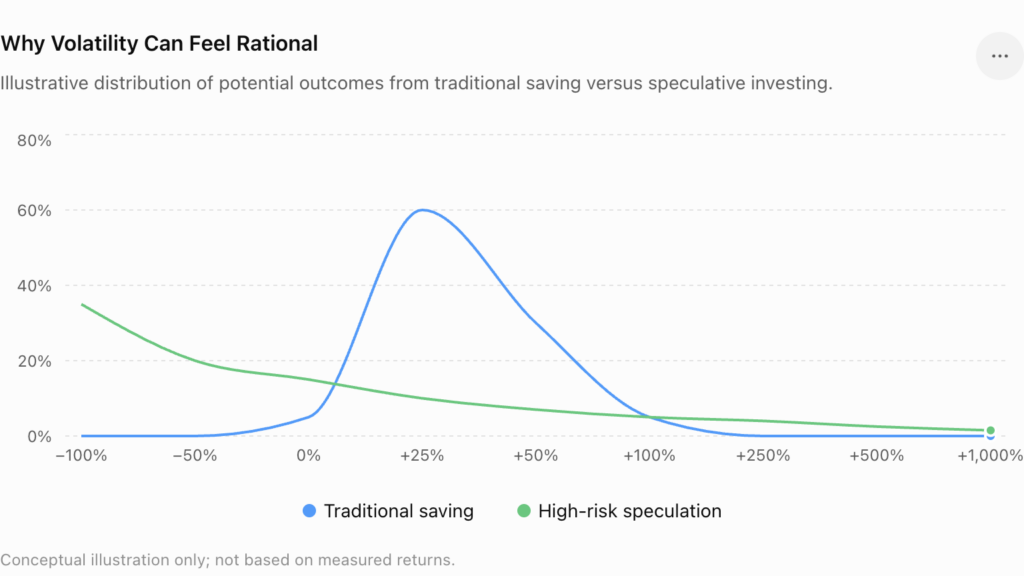
Traditional saving offers a narrow range of relatively predictable outcomes. Speculation creates a much greater risk of loss but also a long right-hand tail containing the outcomes capable of changing someone’s life.
Financial advisors call this the “lottery ticket mentality,” and portfolios reflect it: among young investors, it’s become the norm to allocate 30% or more of their funds to cryptocurrencies, prediction markets, and other alternative assets numbers that would make a traditional financial planner swoon. But this term misses the point: in fact, a lottery is pure chance with a terrifyingly low expected value.
In reality, Generation Z is doing something more complex and interesting: mixing real gambling, semi-skilled speculation, and regular investing in a single portfolio, and sometimes they don’t always distinguish between the three.
Everything Became a Market, and Every Market Became a Game
Today, a 20-year-old carries a bookmaker, a brokerage, a cryptocurrency exchange, and a prediction market in their pocket, all operating 24/7, all developed by teams dedicated to engaging users. This was hard to imagine a century ago, but now the world has accelerated dramatically and globalized.
Trading apps have borrowed the aesthetics of games featuring winning streaks, confetti, and instant execution, while betting apps have borrowed the aesthetics of trading, with real-time odds like tickers and “withdraw” buttons that feel like closing a position. Prediction markets have completed the merger: on platforms like Polymarket, you don’t “bet”; you buy a contract on an event, watch it trade like an asset, and exit whenever you want. The line between investing and gambling has effectively blurred.
For a generation raised on video games, this seems more natural than transgressive. Sports betting, following the wave of legalization that swept the US in 2018, didn’t need to attract Generation Z; in fact, it simply confronted them where they already lived. And the scale of this problem is unprecedented: you can express your opinion on a football match, an interest rate decision, an election, a celebrity statement, or a coin that exists solely as a joke, often within an hour and with the same budget. Previous generations had to go through a lot of steps just to place a bet and invest in something.
The Social Layer: Betting as Belonging
This trend hides another factor that pure economics overlooks: for Generation Z, speculation is a social infrastructure among their peers.
Surveys of young players consistently show that most of them participate in group bets, share predictions on Discord servers and in group chats, follow tipsters and traders as sources of entertainment, and value the collective experience of gambling as highly as the winnings themselves.
CNBC reported on a 25-year-old who spends up to 30 hours a week on sports betting, sharing predictions with the community and subscribing to data platforms to hone his skills. His behavior resembles a serious hobby with profits and losses rather than a vice. Meme waves in the stock market work similarly: for most participants, the GameStop saga was less a financial event than a collective one, led by Roaring Kitty. Behavioral researchers studying that period directly described this as community behavior: isolated people finding connection within a transaction.
Older generations bowled together; this generation holds the same four-way accumulator bet together. One might question the risk profile, but the underlying need shared interests, shared history, the opportunity to sweat it out with friends on Sunday is as old as time.
The Bill: What the Data Says About the Downside
TransUnion found that total monthly debt payments increased by 27% for Generation Z, significantly outpacing both inflation and wage growth over the same period. A New York Federal Reserve analysis found that in states that legalized mobile sports betting, loan delinquency rates rose, with delinquency rates among bettors under 40 increasing by approximately 26%, more than three times the increase seen in older age groups.
A Credit Karma survey found that nearly a quarter of sports bettors reported financial difficulties related to their betting, nearly half said it affected their mental health, and Generation Z was the most vulnerable group: 37% of respondents identified themselves as dependent.
This is the trap hidden in the rational response narrative. The logic of buying variance only works if the potential damage is truly limited and the money at risk is money you can lose. Data suggests that for a significant portion of young players, this is not the case: speculation is carried out with credit cards, and variance is purchased with borrowed funds. A calculated lottery ticket and a debt-financed habit look the same on the main screen. But they end very differently.
So Is Gen Z Wrong?
They’re not wrong in their diagnosis. The traditional path has indeed deteriorated; calculations around wages, housing, and education have indeed failed; the sense of structural backwardness is reinforced by numbers, not emotions. They’re also right that the wall between investing and gambling has always been thinner than the respectable world has admitted; ask anyone who traded options in 2021. A generation that views all forms of risk as a single, continuous spectrum is, in some ways, simply more honest about this issue than its predecessors.
The old advice “if you work hard, you’ll make money” failed not because hard work and saving are foolish; it failed because it promised an end goal that the market, after massive inflation, could no longer deliver. In a world where the uncertainty index has peaked, it’s very difficult to predict what will happen in a year or two; now the market rules have adapted to this paradigm.
Generation Z hasn’t stopped believing in the future; they’ve stopped believing that the future can be achieved with the speed of a savings account, and have begun seeking leverage in bookmakers, tokens, and prediction markets that pay out based on the state of the world itself. You might call it a gambling problem or an overestimation of hope, but the data suggests it’s both, often amounting to the same thing. The generations that teach them built their wealth in a world where patience was reliably rewarded. Generation Z is betting differently: that in their world, that’s not the case, and like any bet, this one will ultimately be decided by reality, not debate.